

How Boston's Feast Of All Feasts Became The Food Celebration It Is Today

Boston is a curious city, culturally speaking — if we wanted to write a cliche essay, we could call it a "land of contrasts." On the one hand, it was founded by a bunch of Puritans, which means there's still some elements of starchy, buttoned-up New England fuddy-duddiness. (Quoth native son of Massachusetts Chris Fleming: "if you wear a weird pair of shoes in Boston, you will be fed to the Dropkick Murphys.") On the other hand, if you ask someone their mental image of a Bostonian, it'll probably be some guy in a Red Sox cap winning a game of Edward Fortyhands. So maybe it's not that much of a surprise that there's a major street party that occurs every year, the Feast of St. Anthony, in celebration of Italian food and culture.
If you didn't grow up Catholic, St. Anthony of Padua was a Portuguese preacher who lived in Padua, Italy and was so popular that he was canonized less than a year after his death. He's commonly considered the patron saint of lost things, so if a Catholic misplaces something important, it's customary to pray to St. Anthony for guidance. (It never quite worked for me, but I suppose ol' Tony had bigger fish to fry.) The feast day celebration in Boston started in 1919 as a continuation of celebrations held in the old country and has grown to the point where it's often called the "feast of all feasts." (Ironically, it's not actually held on the feast day of St. Anthony, which is June 13th; usually it's held in the last week of August.)
The Feast of St. Anthony is a celebration of Italian cuisine
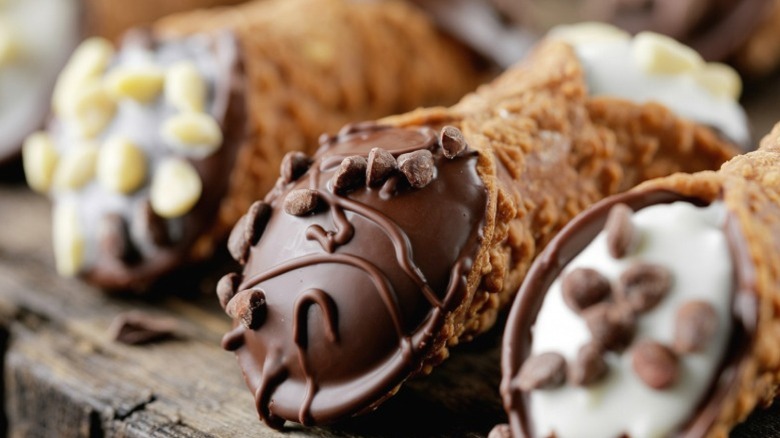
The Feast of St. Anthony isn't entirely about the feast. There's a parade, too, where the Statue of St. Anthony proceeds through the streets of Boston's North End neighborhood, as well as an open air mass. But they don't call it the "feast of all feasts" for nothing, do they? There are hundreds of pushcarts available for your perusal, selling Italian (or Italian-American) favorites like sausage, pepper and onions, pizza, calamari, and cannoli. (No, we're not going to have discourse about the authenticity of Italian cuisine in America — that's an argument between you and your possibly-invented-during-World-War-II carbonara.)
You can also get prosciutto, piled high on a bun; stuffed artichokes, a favorite of Frank Sinatra; and zeppole, which are kind of like the popular carnival treat deep-fried Oreos (except without the Oreo). And don't worry: you don't have to be a Catholic to attend the Feast of St. Anthony. In fact, it might help you avoid the Catholic guilt that could sneak up on you after eating a feast's worth of food.