

The Boozy Addition That Makes Olive Garden's Bolognese Irresistible
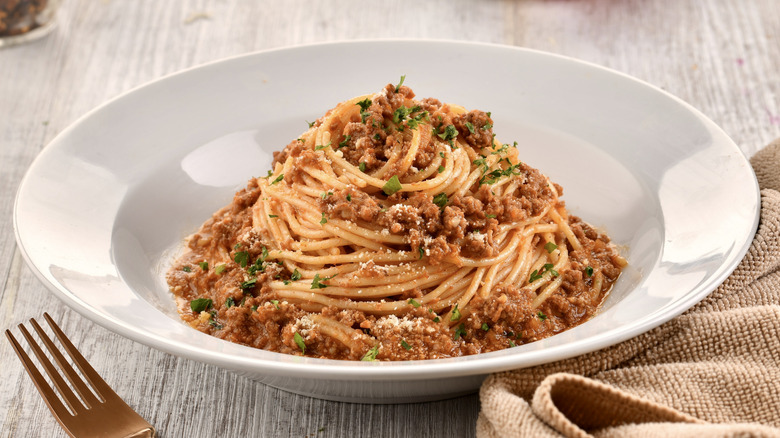
Olive Garden offers a unique Italian American experience for all who enter its establishments. From Olive Garden's signature endless breadsticks to its inviting atmosphere, it's no secret why the Olive Garden experience continues to delight us. What many customers crave most is Olive Garden's to-die-for saucy pasta entrees, like creamy Alfredo and garlicky scampi. Customers especially love the chain's Bolognese sauce, and for a noteworthy reason: the inclusion of red wine.
While a traditional Bolognese sauce includes white wine, Olive Garden swaps it for red — perhaps for its bolder, deeper flavor profile. The wine deglazes the pan, and as it reduces, it lets the rest of the Bolognese's flavors shine. Olive Garden also incorporates classic ingredients in its Bolognese: aromatics like onion, celery, carrots, and garlic; ground beef and Italian sausage; crushed tomatoes; and fresh herbs like rosemary and sage. Other Bolognese sauces include milk to facilitate meat tenderization, yet Olive Garden's version is dairy-free.
Unfortunately for its fans, Olive Garden quietly removed its Bolognese sauce from its menu and replaced it with a standard meat sauce. Although there is no official statement from Olive Garden explaining the swap, fans can presume this was done in efforts to streamline the menu — the meat sauce still includes beef and Italian sausage. Luckily, you can recreate this dish at home with all — or perhaps more — of the delicious fixings Olive Garden's previous Bolognese included.
Making Olive Garden's Bolognese sauce at home
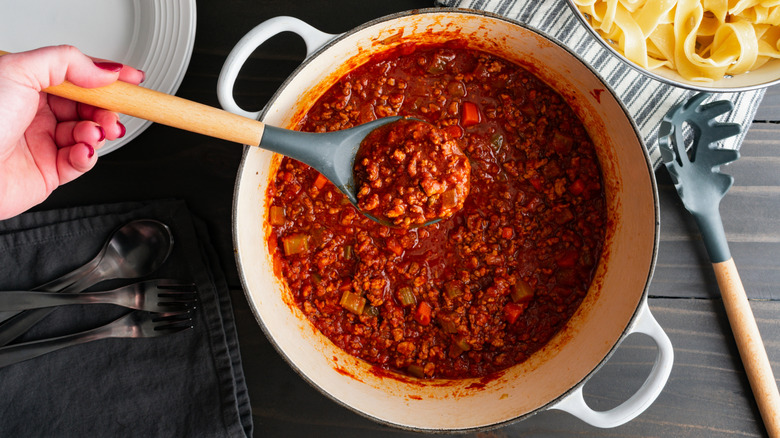
Olive Garden may have removed its Bolognese sauce from its menu, but that doesn't mean we can't still enjoy it. Anyone can reproduce Olive Garden's signature sauce. Just remember its key ingredient: red wine. The specific wine Olive Garden uses isn't known, but recipes that call for it typically incorporate a dry variety to make the sauce more flavorful without introducing too much sugar. Dry reds like cabernet sauvignon, zinfandel, and syrah all have flavor profiles that complement those of a rich Bolognese sauce.
In other Bolognese sauce recipes, chefs add milk into the sauce to help tenderize the meat. So long as you tolerate lactose, adding milk into your Bolognese could be the one thing that takes Olive Garden's recipe to new heights, as the milk additionally balances the acidity of the wine and tomatoes. Because the sauce will simmer for a while, you won't explicitly notice the milk is in there. Another way to elevate Olive Garden's recipe is by adding pancetta to the mix. Because of the fat and complex taste, this meaty addition makes the sauce a whole lot more flavorful.
As a fairly heavy sauce, Bolognese needs a pasta that can support it. Wide, flat noodles like tagliatelle and fettuccine work best to carry the weight of the dense Bolognese. It also lends itself well to baked pastas like ziti, lasagna, and stuffed shells.