

You're Risking Your Safety If You're Using Your Dish Sponge This Way
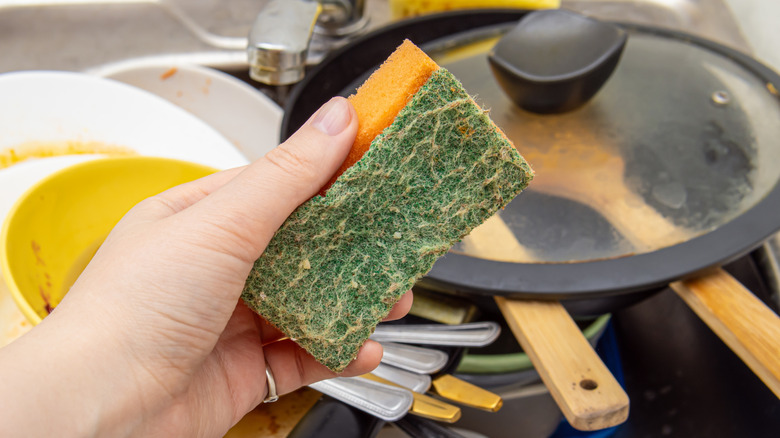
One of the nastiest things in your kitchen (besides that moldy cheese that's fallen behind the crisper drawer) is the kitchen sponge. It may look innocent, but the dirty truth is your sponge is basically a poop-spreader in the kitchen. Study after study has confirmed what chefs and food safety pros have long suspected: Kitchen sponges are crawling with bacteria, often more than what's found on a toilet seat. And if you're using one to mop up raw meat juices? You may as well roll out the welcome mat for E.coli.
That's because meat juices aren't just gross: That puddle at the bottom of your chicken package is loaded with bacteria that thrive in warm, damp environments. Guess what else is warm and damp? The sponge you just used to clean the cutting board. Its porous, hole-filled structure is a dream home for microbes, with lots of nooks to hide in, a steady stream of moisture, and a buffet of food particles to snack on.
When a sponge soaks up raw meat juice, the bacteria don't just sit politely near the surface — they dig deep into those pores, and it'll take more than common dishwashing soap to remove them. If you don't take the time to disinfect and routinely change out your kitchen sponges, you're just spreading that bacteria far and wide every time you swipe it across a countertop. It might look clean, but it could cause you a miserable night of food poisoning.
Kitchen sponges and raw meat juices should never meet
To get your sponge squeaky clean, experts recommend microwaving your sponge for one minute or running it through the dishwasher with a full wash and dry cycle. This does work, but you've gotta do your due diligence. Make sure to disinfect your sponge every few days, and replace it every one to two weeks.
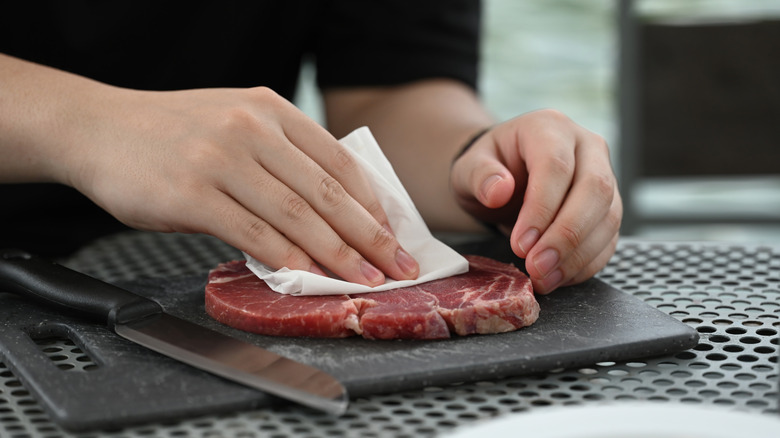
But when it comes to meat juices? The treehugger in you might scream, but paper towels are the simplest, safest option for dealing with raw meat messes: Use it once, toss it, and forget about it. If you're trying to cut down on waste, reach for a dishcloth — but throw it straight into the wash (hot cycle, please) or grab some bleach after it touches raw meat. We're talking water temps over 180 degrees Fahrenheit or soaking it in a bleach-water solution (about 1 tablespoon to 1 gallon). For scrubbing, ditch the sponge entirely and use a dish brush with stiff bristles. It dries faster, harbors fewer bacteria, and looks way better than your dirty little sponge.
At the end of the day, sponges have their place — wiping up a spilled glass of rosé, sure, or scrubbing a sticky jam jar. But when raw meat enters the scene, it's time to retire the sponge and reach for something disposable or easily sanitized. Think of it as culinary self-care: Fewer germs and more peace of mind. Because nothing kills the mood of a perfectly cooked steak faster than a side of salmonella.