

What's Up With Those Tiny Handles On Maple Syrup Bottles?
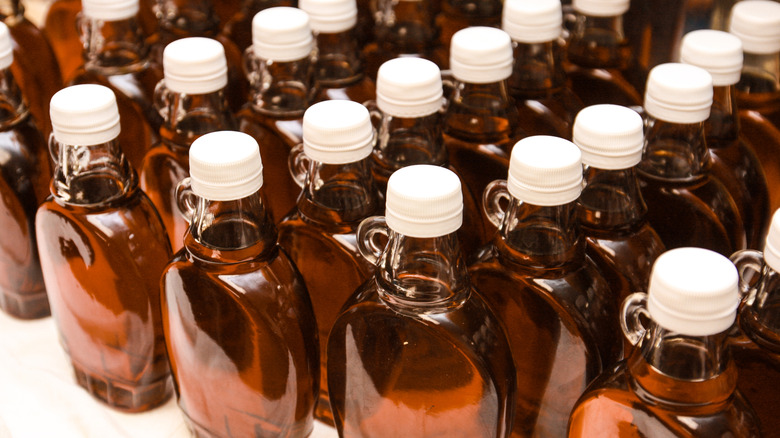
As someone who lived in New England for more than 15 years, I believe that any syrup poured over pancakes must be tapped from a tree and sealed in a glass bottle accented with a tiny, useless handle. But where did that iconic feature come from, anyway? According to a maple syrup historian, the 1930s.
In 1922, Joseph Klein filed a patent for a maple syrup jug with an appropriately sized handle for the Little Brown Jug Products Company. Then, two brothers each designed and patented a glass maple syrup bottle with a small angular handle more than 15 years apart. Edwin W. Fuerst filed his "design for a jug" in 1932. Once approved in 1933, the patent was assigned to the Owens-Illinois Glass Company. (Curiously, the handle on the Little Brown Jug Products Company containers subsequently shrank.) Edwin's younger brother, Brooks D. Fuerst, was a professional glass designer at Owens-Illinois, and filed his maple syrup flask idea, "jug or the like," in 1949.
Despite Edwin's design being rounder, larger, and heavier than Brooks', they both decided on a small angular handle. Moonshine, molasses, and maple syrup were stored in large, durable containers with functional handles, so why did the Fuersts design bottles with a handle that only people with tiny pinkies can use? Their thinking remains unknown. In the 1990s, the angular handle evolved into a rounded one, and companies decided it would stick around. In fact, many of the store-bought maple syrup brands we ranked from worst to best sport the little handle.
A throwback design detail
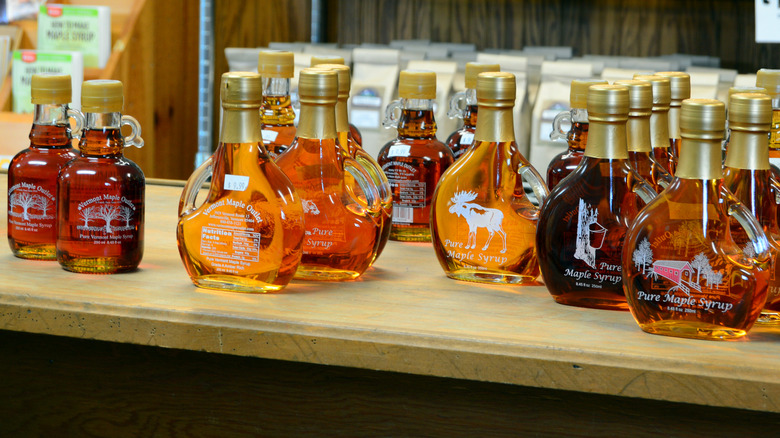
The maple syrup bottle's tiny handle is an example of skeuomorphism, which refers to design elements that echo older forms. "You hold on to the design element to remind us of what the thing was like and is doing," science communicator Hank Green said. A skeuomorph is "an ornament or design representing a utensil or implement," and in this case, it's the tiny handle (via Merriam-Webster).
"We realize it doesn't have much function, but somehow it feels wrong to not have it," Steve Anderson, a third-generation "syrup boss" explained (via Reader's Digest). The nostalgia factor puts the maple syrup tiny handle next to the recycling bin design on your computer — it's just the way it is.
Alongside the tiny handles, maple syrup bottles are traditionally glass, allowing them to showcase the syrup's beautiful colors, each corresponding with a different grade (Golden, Amber, Dark, and Very Dark). Knowing the difference between each grade of maple syrup and how to use them will help you add maple syrup to every meal. Regardless of grade, in your opinion as a consumer, if the maple syrup jug doesn't have the little handle, does it taste as good?