

The Secret To Making Tender, Restaurant-Quality Prime Rib At Home Is This Temperature Tip
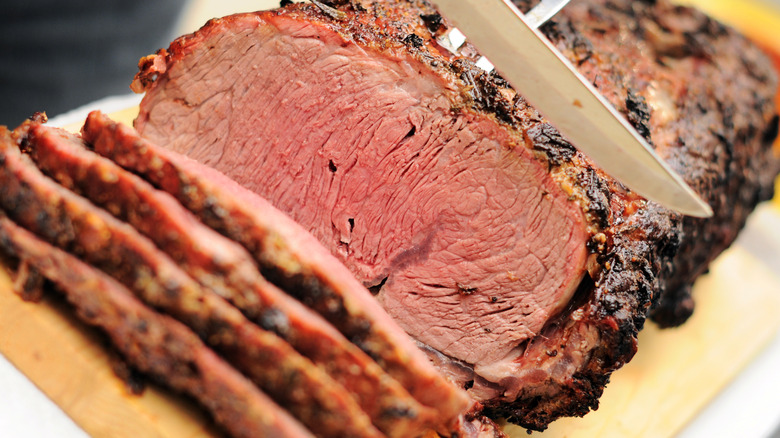
Why does it seem like prime rib always tastes better at a restaurant than when you make it at home? It may be due, in part, to that eye-popping price you probably paid, since if you spent half a week's pay on an entree, it darn well better be good. Another reason, however, is that restaurants — steakhouses, in particular — have plenty of experience cooking prime rib, whereas it might not be the kind of thing you make on a regular basis. If you're preparing to give it another try, though, Scott Thomas of the The Grillin' Fools website says the secret to making restaurant-worthy prime rib lies in the temperature.
Thomas insists that prime rib should be cooked without preheating the oven. (If you're not using a smoker, that is; as the name of Thomas' website implies, he is partial to outdoor cooking.) Starting in a cold oven, he says, allows the meat to come up to temperature slowly and achieve a more even temperature. It also results in something more visually appealing. "Start the prime rib in [a] hot oven, that grey band will form around the outside," he explains. "Start it cold, and that band is reduced or eliminated. The grey band will have a nice crust along the outside, but the grey meat underneath is just not that appetizing."
Why does prime rib cook differently from steak?
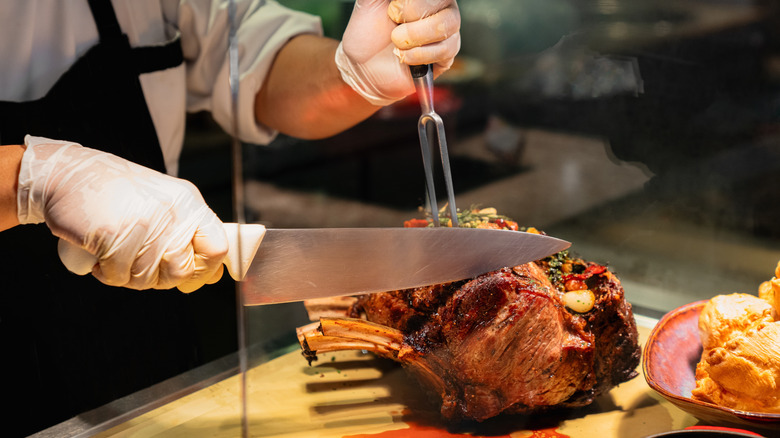
According to Scott Thomas, the term prime rib doesn't mean it's just an extra high grade of beef. (USDA-certified prime beef is a cut above choice, but not all prime rib is prime grade.) Instead, he tells us, "The term prime is referring to the primal cut, which is the whole roast ... That being said, the primal rib or, more accurately, the standing rib roast, is just a bunch of ribeye steaks that have not been carved into steaks yet. Deconstructed ribeye steaks, if you will." What differentiates prime rib from ribeye is the fact that it is cooked while still intact.
If you order prime rib in a restaurant, you're probably not going to get the whole thing; instead, you'll be presented with a thick slab of meat that has been sliced after cooking. (Unless you're eating at Ward's House of Prime Rib, that is, since this restaurant allows you to order up to 22 ½ pounds of the eponymous specialty.)
If the primal rib had been cut while raw, the resulting ribeye steaks could have been grilled or pan-fried hot and fast. "Leaving the standing rib roast, or prime rib, whole means it takes longer to cook and [there's] less surface area [from] which to lose moisture, thus [it] is generally juicier than when carved into steaks," says Thomas. He did note that there's one downside to grilling or smoking a prime rib, since it will have less bark than individual steaks. But the larger surface area allows it to absorb more smoky flavor, as it cooks for a longer time at a lower temperature.
How to reverse sear prime rib
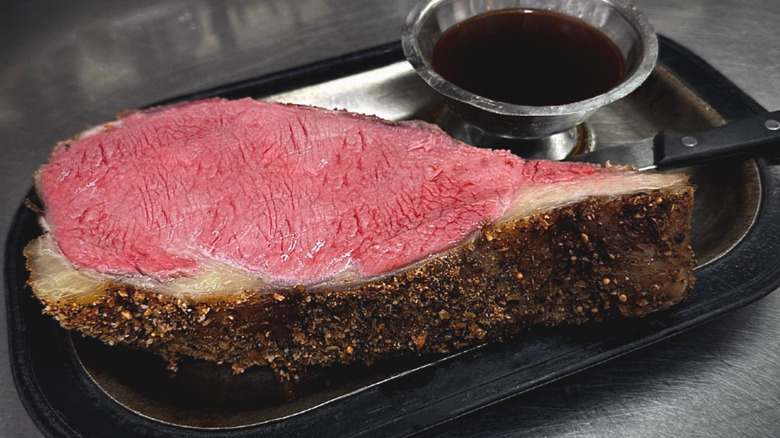
One cooking term that chefs like to throw around when preparing steaks is "reverse sear," which means that you cook your meat at a lower temperature before finishing it off at a higher one. The reverse sear technique is advisable in some cases, but not in others — it works better with thick steaks than thin ones, since the latter may wind up dry and overdone. (The sear alone is sufficient to cook them.) As an intact prime rib is quite substantial, though, a reverse sear works pretty well.
For reverse searing, Scott Thomas says, "I never recommend cooking to time. Always cook to temp. Time can be impacted by the size of the roast, amount of marbling, and heat of the oven or grill. If cooked outside, weather conditions also play a part." He advises that prime rib should be cooked until it's 10 to 15 degrees below the desired degree of doneness, instructing: "Then grab a cast-iron pan or griddle and sear that monster over wicked high heat to get an amazing flavor crust on the outside." If you don't have a frying pan big enough to fit an entire prime rib, you can also reverse sear it in a very hot oven (500 degrees Fahrenheit) or slice it and brown the individual slabs. However you sear the prime rib, this step should be followed by 10 to 15 minutes of resting to ensure that the juices stay inside the meat where they belong.