

The Bakery-Approved Ways To Fix Stiff Buttercream
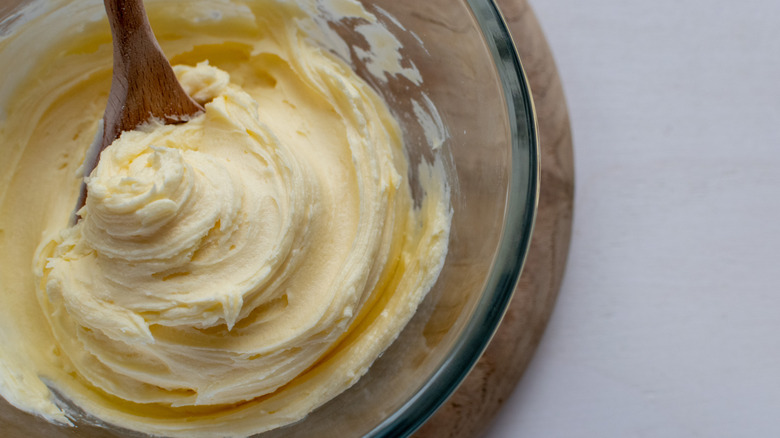
While it is just one of many different types of frosting, buttercream is likely the most popular kind for cakes made in the United States, leading many to know the occasional frustration that comes when its texture isn't quite right. This can be a matter of buttercream being lumpy, thin, or broken, and it can also become too hard to use easily.
We discussed the annoyance that comes with stiff buttercream and how to potentially fix it with Victoria Fisk, who is both the cofounder and confectionery chef at Bouqedibles. She first explained the most likely reason why your buttercream is too firm, saying, "Buttercream stiffness is heavily dependent on temperature." It is heavier, thicker, and stiffer when it's below room temperature, as it would be in the fridge or in a chilly kitchen.
Bringing it up to cool room temperature (between 64 and 68 degrees Fahrenheit) slowly yet surely and then whipping it is the key to improving its texture. "Don't try to rush the process of bringing it to room temperature before whipping," Fisk advised. "Otherwise, it can become greasy, develop an unpleasant color, and turn too heavy to pipe." Here's one method Fisk suggested: "You can warm a very small portion in a hot water bath or, incrementally, in the microwave (on a gentle setting), then gently mix it back into the main batch. If this helps bring the entire batch to room temperature, you can whip it." If the buttercream is still too cold, you can repeat the process using small batches.
Adding other ingredients can also improve your buttercream's texture
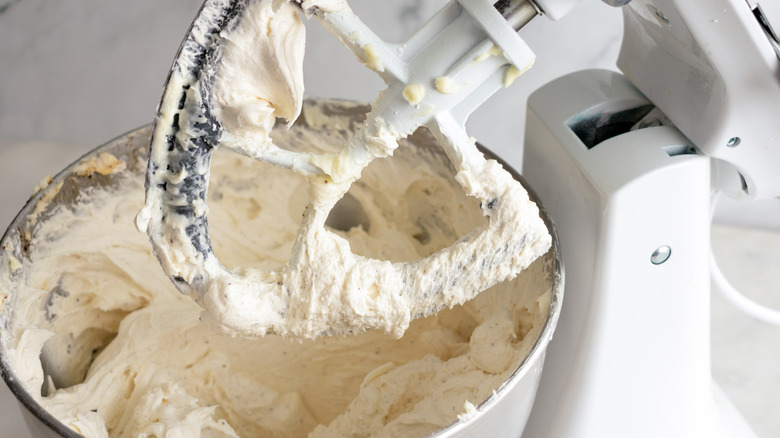
Victoria Fisk also noted that warming up the frosting itself can be difficult to get just right, so there are other methods you can use to hopefully get better results. Including some extra ingredients — be they new additions or ones that are already included in most buttercream recipes — can really save the day as far as texture is concerned. "If the buttercream is still too stiff, you can add room-temperature milk or cream or a fruit or berry syrup for flavor, 1 teaspoon at a time, mixing manually," Fisk instructed. This should smooth out the frosting to its ideal texture, but Fisk said you should also whip it again after this step is complete.
"Once the buttercream reaches a smooth consistency and comes to room temperature," Fisk began, "you can whip it. Try whipping a small portion first to avoid spoiling the entire batch." This last part is important to keep in mind, as overwhipping (or overmixing in general) can cause breaking, grittiness, or lumps. In these cases, whipping cautiously and removing air bubbles from the buttercream using a spatula or the slowest setting on your mixer are likely your biggest keys to success.