

The Most Important Consideration To Take When Mixing Beers, According To An Expert
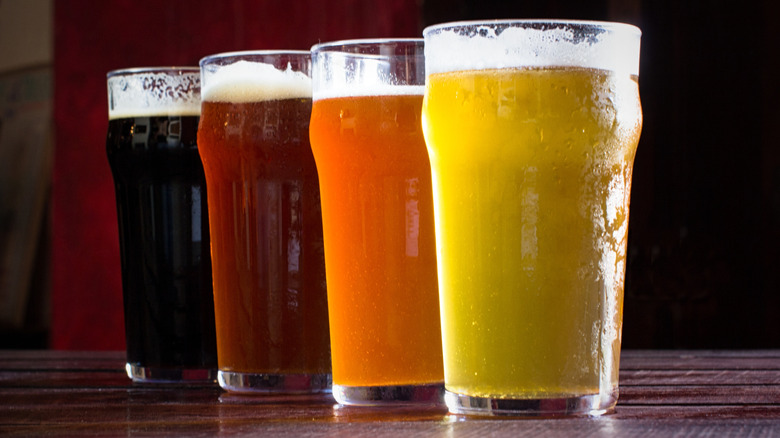
Many beer cocktails begin by adding some kind of mixer to the basic brew — beer plus orange juice makes the perfect beermosa, while beer plus olives and brine equals a beertini. However, some drinks involve combining more than one type of beer. Some beer pairings work great, but others ... not so much. Chris Cusack, who owns a Houston pizzeria and cocktail lounge called Betelgeuse Betelgeuse, says that certain beers don't really play well with others.
"The most important thing to consider when mixing beers is intensity — don't choose a beer that will totally dominate the other," he counsels. As an example, he says that a lager mixed with an IPA would water down the latter and appeal to neither IPA fans nor those who don't much care for this variety. He also recommended taking the beers' sweetness and bitterness into consideration, as one can help offset the other in a complementary fashion. (Case in point: A fruit beer blended with barleywine can highlight the latter's caramel notes.)
However, he adds, "I would consider alcohol content to be a backseat consideration. It's not [un]important, but generally speaking, very high alcohol beers are going to dominate through flavor as well as ABV." For the best beer pairings, it's advisable to choose beers with a similar alcohol level.
These beer blends are tried and true
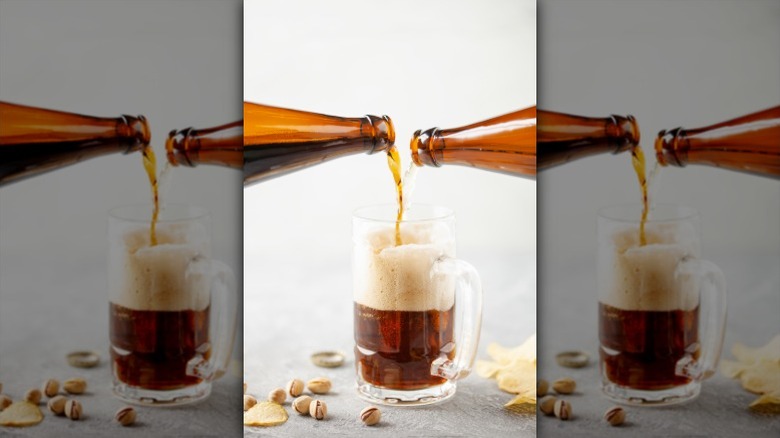
Perhaps the most famous beer blend is the Black and Tan, which consists of any dark beer mixed with a lighter one. For best results, however, you're going to want two beers of relatively equal strength, such as a pale ale and a stout. Chris Cusack also mentioned the Snakebite, which pairs a beer with a malternative (hard cider), although a variant called the Whitesnake is made with hefeweizen and lager, so it fits within the beer-plus-beer parameters. While these drinks are often mixed 50-50, Cusack suggests, "For a slightly more nuanced take, try a 60-40 or 70-30 ratio in your blends, allowing flavors to complement rather than dominate."
Cusack's picks are amber lager or bock paired with a pilsner, a wheat beer with pale ale, and a schwarzbier with a rauchbier. Reddit has weighed in with other suggestions, including stout with pumpkin beer, stout with barley wine, chocolate stout with a fruit lambic like the raspberry-flavored Lindemans Framboise, and IPA with a fruited beer.
Over on Quora, a user contributed an interesting bit of British pub lore. It seems that old school pubs would often serve four types of beer: light (light ale), bitter, mild, and old (aged porter). Drinkers would frequently request that these be combined, and a few of the combos even had their own special names, such as Grandmother (old + mild) and Mother-in-Law (old + bitter). While beer blending fell out of fashion around the turn of the millennium, it's apparently on the upswing again.