

Before Cleaning Your Kitchen Floors With Vinegar, Make Sure They're Not This Material
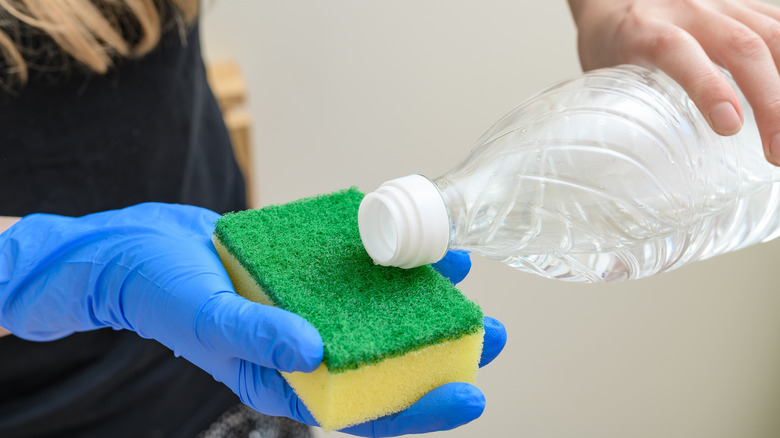
Vinegar can be a vital tool in keeping your kitchen clean. You can use vinegar to fix your smelly sink and can apply it to stovetops to break down built-up grease or mineral deposits. It can even be used as a solution to clean your floors from dirt, dust, and food spills. However, before you start scrubbing your tiles with a vinegar solution, you should check to make sure your floor isn't made from natural stone such as limestone, marble, or travertine. If it is, using vinegar can damage the stones, causing color changes and weakening over time.
If there's one important thing you should know about cleaning with vinegar, it's the impact its acid can have on surfaces. Mopping or wiping with vinegar will remove spills and stains, but on stone surfaces, it can also remove the finish and cause discoloration. This leads to dullness and makes the surface more susceptible to damage and stains. Even if damage isn't immediately visible, it can happen at a microscopic level that will become more apparent over time.
If left on stone too long, vinegar can cause etching or leave permanent spots that can be expensive to remove. Even durable granite can be damaged since vinegar can break down the finishes commonly applied to this stone. This damage can be so severe that a full replacement may become necessary. The reason behind this is simple chemistry – high amounts of acetic acid that are great for cleaning also chemically react with the minerals found in natural stone, gradually eating away at the surface.
There are better ways to clean stone floors
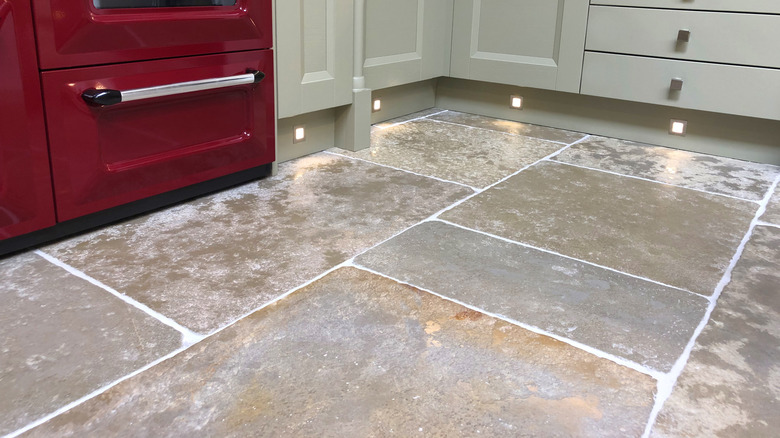
While cooking vinegar and cleaning vinegar are quite different, it's important to be careful when using both around natural stone surfaces. Luckily, there are plenty of cleaning products available if you have floors or countertops made of marble, limestone, granite, or travertine. White distilled vinegar has a pH of roughly 2.5, while acids are defined as having a pH lower than 7. Look for a cleaning product that has a neutral pH of around 7 to avoid harsh acids that eat away at the natural rock or delicate finishes. You should also avoid bleach or other strong chemicals, as they can have a negative impact, too. Even highly alkaline cleaners may be harmful to your natural stone floors, so the idea is to stay as neutral as possible.
When cleaning granite, simple pH-neutral soaps mixed with water, finished with a microfiber cloth, will do. There are also specialty stone cleaning sprays and polishes that help maintain the integrity of natural stone tiles and flooring, so you might want to seek those out. Consider getting your floors sealed regularly to prevent damage from accidental red wine or balsamic vinegar spills.
If you want to keep cleaning your plates, appliances, and non-natural stone surfaces with vinegar, feel free! Just be aware that anything with a high acidic level is rough on waxed floors as well, since it can break down the protective layers and harm the flooring underneath. When cleaning, you should also avoid using vinegar on unfinished natural wood surfaces for similar reasons.