

The Meager Rations General Washington And His Troops Dined On At Valley Forge
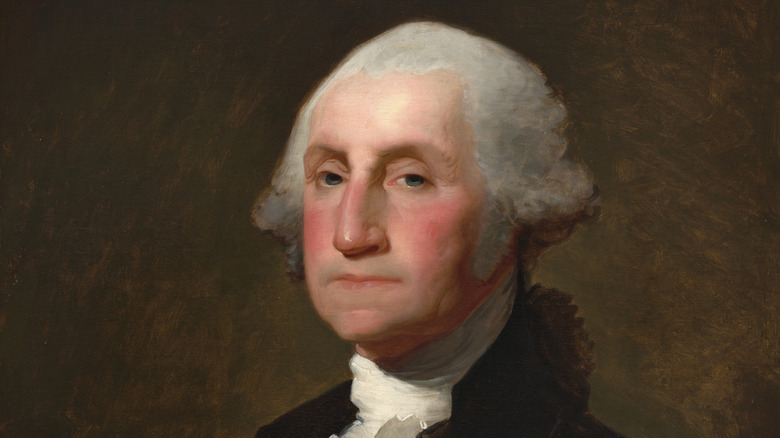
The rumblings of the American Revolution began in 1754, and by 1775, George Washington was appointed Commander in Chief of the Continental Army. Numerous battles against the British army ensued, and following losses in both Philadelphia and Fort Mifflin, PA, Washington positioned his troops in Valley Forge. From December 1777 through June of 1778, Washington and his army hunkered down there, enduring a bitter winter that saw his men on the brink of starvation.
Each soldier in Washington's army was supposed to receive the Revolutionary War equivalent of the M.R.E.s that remain popular today: daily amounts of beef, pork, or fish, flour or bread, cornmeal or rice, and whiskey or rum — but no Madeira wine, which General Washington loved so much. But this wasn't the case. General Thomas Mifflin, the Quartermaster General who was in charge of obtaining food and supplies, once reported that the camp's rations consisted of 25 barrels of flour and a little salt pork. There were roughly 12,000 troops at Valley Forge, and Washington had initially estimated that 100,000 barrels of flour and 20 million pounds of meat were needed to feed his men for a year. As a result, the army often endured days on little to no food at all.
One soldier's account described each man receiving half a gill of rice at Thanksgiving (that's about ⅛ of a cup) and some vinegar. Others mentioned having nothing but fire cakes (biscuits made of flour, water, and salt) and water. Washington wrote constantly to Congress during this period, begging for aid and food supplies, but his requests went largely unanswered and relief was only sporadic.
The many hurdles Washington faced obtaining food
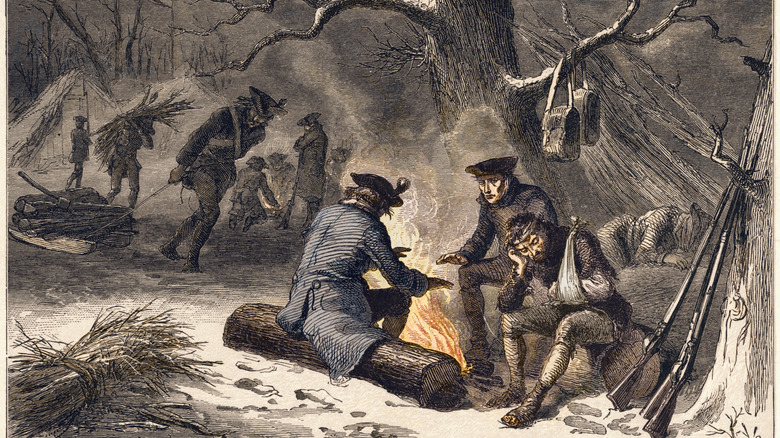
Aside from inexperienced commissary and quartermaster generals, getting food in winter was no easy feat. Wildlife to supplement the meager supplies would have been sparse, and farmers were often not cooperative with the army, and drove up prices of the food they sold to the troops. This was likely due to the fact that many of them did not trust the men, and that Continental currency was constantly losing its value. At one point, currency had no value, leaving Washington and his troops to pay farmers and merchants with "IOUs" that were rarely reimbursed.
In addition, supply deliveries were impeded by ice and snow-covered roads. Washington did what he could to satisfy both his troops and the surrounding civilians. When he learned that troops were stealing supplies from farmers, he implemented strict rules on soldiers leaving camp. He also required his men to document receipts of what they received from farmers so they could be reimbursed later from Congress, but farmers didn't trust this arrangement.
Finally, in the spring of 1778, and after approximately 2,500 troops had died in part from starvation, Congress finally approved supplying Washington with an experienced commissary and quartermaster general to adequately equip and feed the army, although supply delivery remained sporadic. On June 18, 1778, the Continental Army left Valley Forge and returned to Philadelphia, which the British army had recently abandoned. It would be nearly another half-decade before Washington and his army would declare victory over Britain, which our first President celebrated at a New York restaurant.