

Artemis 2's Menu Is A Major Upgrade From Apollo 11's
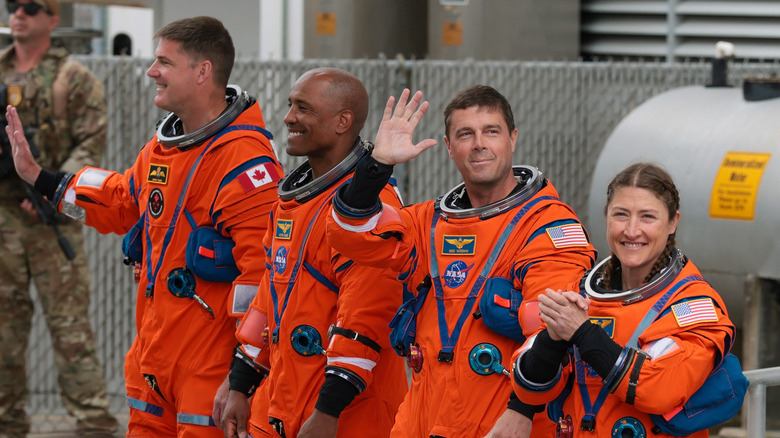
In all the chaos of the news cycle, the launch of the Artemis 2 may have gotten somewhat lost in the shuffle. (I personally didn't find out about the planned launch until after the spacecraft was already in orbit.) While it may not be the headline-grabber that the first manned space flights were back in the late '60s and early '70s, it's nonetheless newsworthy since it marks the first return of astronauts to the moon's atmosphere after more than 50 years. Legendary astronauts Neil Armstrong (were he still alive) and Buzz Aldrin (still going strong at 96) might experience some FOMO if they were to check out the menu of the latest space flight, though. Compared to what they had to eat while on the Apollo 11 mission, the Artemis 2 menu is practically Michelin-star fine dining.
On the Apollo 11, the astronauts dined on such dubious-sounding dishes as bacon squares (yes, space bacon was a thing) and date fruit cake. (Fruit cake in space – truly the stuff of science fiction nightmares.) The National Air and Space Museum also currently contains a freeze-dried pouch of rather unprepossessing-looking chicken and rice that someone understandably chose not to eat during the flight. Artemis 2, however, boasts a menu with 189 different options. These include mango-peach smoothies and green tea to drink, barbecued beef brisket and mac and cheese as main courses, and five different types of hot sauce along with other condiments including maple syrup, chocolate spread, and spicy mustard. NASA points out quite proudly that five of these items are Canadian-made. (Yay for international cooperation!)
The two menus do have a few things in common
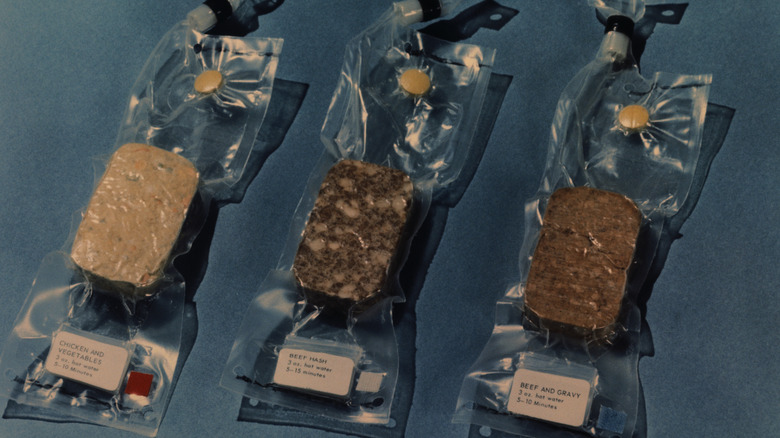
While Artemis 2's dining options may not satisfy the pickiest of foodies on solid ground, they stand as a testament to how far space cuisine has come in half a century of evolution. For one thing, it seems astronauts no longer drink Tang in space. (Buzz Aldrin was famously not a fan of the beverage.) Newer drink options (such as pineapple drink and apple cider) as well as some freeze-dried entrees will most likely need to be rehydrated using the spacecraft's onboard water dispenser. This was also the case back in 1969 when the Apollo 11 crew set foot on the moon, since space food has always needed to be as light and compact as possible.
The food options are meant to have a high calorie count. The Apollo 11 astronauts took in about 2,800 calories per day spread out over three meals, for example. The Artemis 2 menu doesn't specify a target calorie count, but volume-saving food bars that are sometimes used to replace whole meals range between 700 and 900 calories each. These high-calorie items are a necessity because space travel burns more calories than earthly activities. Even 2,800 calories per day may be on the light side, since it's possible for astronauts to expend up to 3,500 calories worth of energy per day