

This Is What Happens To Your Body (And Brain) When You Eat Spicy Food
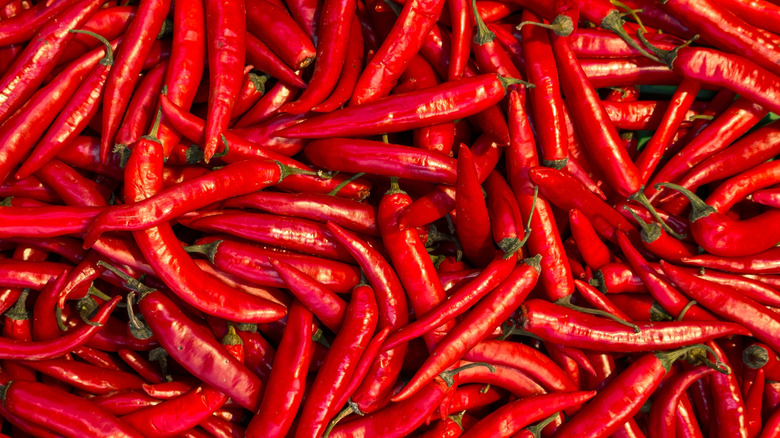
News flash: Your mouth isn't actually on fire when eating spicy foods, but your brain certainly tells you it is. Spicy foods sound off fire alarms in the brain, leading to all sorts of extreme — and sometimes comical — reactions to the heat. But what if I told you there's actually no heat in spicy peppers at all? The chemical capsaicin — found in most chili peppers — tricks our brains into thinking there's heat in our bite.
When we eat something spicy, capsaicin glues itself onto pain receptors on our tongue called TRPV1s. These receptors turn on when our bodies experience extreme temperatures. Because capsaicin mimics blazing heat, the receptors report to the brain that we've consumed something dangerous and threatening. To counteract this threat, the brain communicates with the body and screams "SOS! Cool down!" Even though the heat is an illusion, the capsaicin's trick sends our bodies into full meltdown mode (pun intended) — we sweat, tear up, and turn red.
Capsaicin doesn't stop its trajectory at your tongue; it latches onto more TRPV1 receptors along your digestive tract. Short-term, this can prompt digestive distress like vomiting, increase your heart rate, and can even cause anaphylactic shock for highly-sensitive individuals. Long-term, consuming extremely spicy food — or spicy food in excess — can produce stomach ulcers, induce insomnia, and reduce senses of taste and flavor (but as painful as a really hot pepper might feel, it won't kill you). So with all of this being said, why do people allow themselves to endure such torture when eating spicy foods? The answer rests in the brain's reward center.
The enthralling pain-pleasure loop

You sweat, you cry, you pant — and yet, you take another bite. Why? Because we are conditioned to love the pleasure beneath the pain. As the tongue's TRPV1 receptors activate and signal discomfort to the brain, it releases a surge of chemicals designed to alleviate the distress. These chemicals, known as endorphins and dopamine, create feelings of pleasure and euphoria — a "high" from eating spicy food. These polarizing sensations shed light on why eating spicy foods can be both a gratifying and troublesome experience: Our brains are wired to repeat enjoyable experiences, making spicy foods a painful sensation that we also can't resist.
Eating spicy foods can be seen as a safe form of thrill-seeking, and studies show risk-taking people typically enjoy such dishes. Though the perceived pleasure or pain from eating spicy food is ultimately subjective, it can be an exhilarating challenge, comparable to riding a roller coaster or watching a horror movie. And over time, the reward overrides the discomfort.
This is largely due to an increase in spice tolerance. The more you eat spicy foods, the less likely your pain receptors are to activate, leading to fewer "danger" signals to the brain. Some people possess a greater immunity to spice than others due to genetics and cultural exposure: In high-temperature areas, such as Mexico and many Asian countries, spice is a central part of their indigenous dishes. Reinforced personality traits — and specifically, those linked to traditional gender roles — are also related to spice tolerance in some cultures. Even in the United States, masculinity is often associated with the ability to withstand spicy meals.