

12 Dishes You'll Find At A British Chinese Restaurant That Confuse Americans
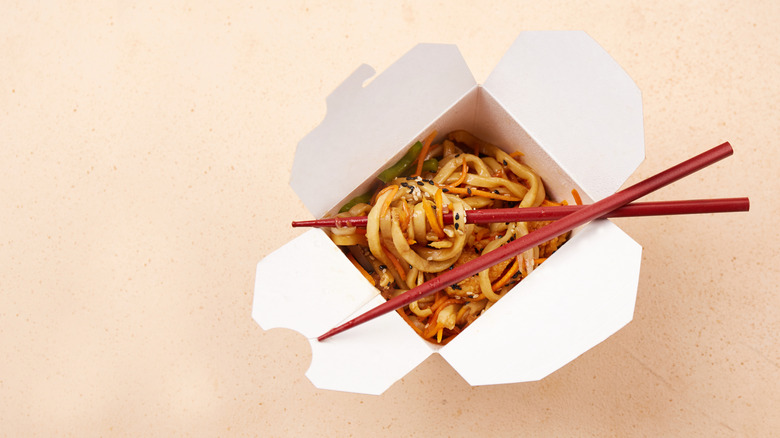
America and the U.K. are two nations separated by a common language, to paraphrase the Irish playwright George Bernard Shaw. And to be sure, you'll find plenty of differences when crossing the pond, linguistic and otherwise: which side of the road to drive on, what to call association football, systems of measurement, etc. But there are plenty of similarities as well.
One thing the people in both places love: Chinese food. There are more Chinese restaurants in the U.S. than McDonald's, at roughly 45,000. Meanwhile, half of Brits eat Chinese food on a regular basis. And the cuisine has now been in both countries for quite some time. There was a significant Chinese community in Lower Manhattan as early as 1800, with the first known Chinese eatery, Canton Restaurant, opening in San Francisco in 1849, during the Gold Rush. London saw its Chinatown come to fruition in the 1880s, with the first restaurants catering to all locals popping up around 1908. Since then, the U.K. Chinese "takeaway" – sometimes called "cheeky Chinese" – has become its own subgenre of the globalized fare.
Over the past century-plus, the two regions have shared a love affair with Chinese food. And, naturally, the transplanted cuisine has itself taken on the identity of its adopted countries. The result is two nations separated by a common food, with staple menu items for Brits that are unrecognizable to Americans. Here are a dozen of those differentiating dishes.
Salt and pepper chips
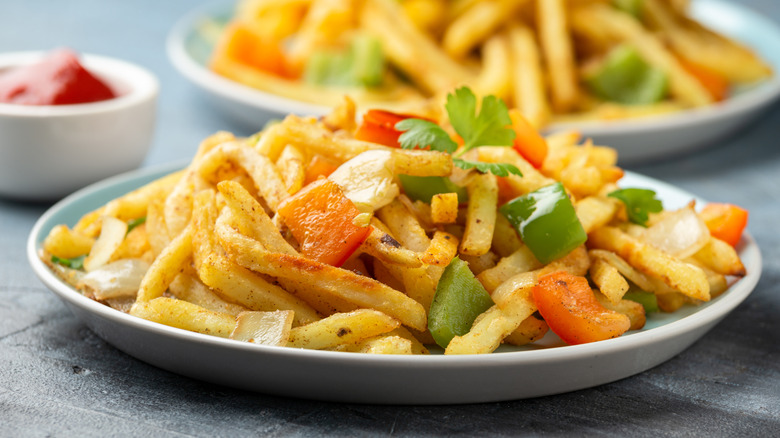
What Americans call chips and what the Brits call chips is a well-known, almost cliché contrast. But, for those whose main residence is under some type of stone: Chips in the U.K. are french fries in the U.S., whereas chips in the latter are called crisps in the former. That dissimilarity extends to one of the more popular British-Chinese takeout dishes: salt and pepper chips.
What are salt and pepper chips? They're definitely not the variety of snacks sold by Utz stateside, but fries mixed with a slew of seasoning and flavorings — generally including ingredients like peppercorns (black and Sichuan), onions, spring onions, red and green peppers, garlic, red chili, chili flakes, Chinese five-spice, caster sugar, and sea salt.
Toss it all together, and you get a tasty jumble of savory and spicy that makes for either a sufficient standalone meal or a lovely complement to a spread. It's one of those dishes that can only come from a mashing of cultures and a diaspora adapting to a new home country. If ever there was a fusion of British and Chinese palates, it's right here.
Crispy seaweed
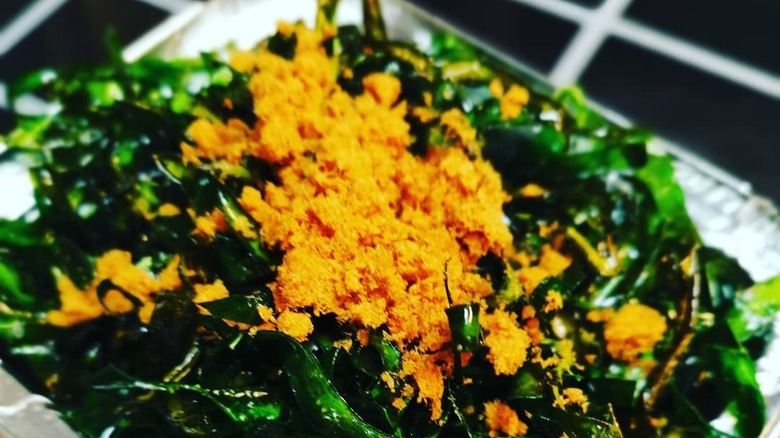
It doesn't help that this British-Chinese offering, already unknown to the American eater, has a bit of a misleading name. The crispy part is certainly true, but the seaweed part is basically a lie. It's not seaweed at all but spring greens. When the spring greens are cooked this way, they take on the look of seaweed. But nothing about this leafy veggie is ocean-born.
But what exactly are spring greens, a confused American may additionally ask. Spring greens are young cabbages, the first ones of the year to grow. Without the hard, taut center you're used to seeing in other cabbages, the leaves are fresh and tender. Being a part of the Brassica family, spring greens have the bitter characteristics of its cousins, kale and bok choy. And like its family members, spring greens are highly nutritious — packed with vitamins, minerals, and fiber that are great for your immune system and overall health.
For the dish, the spring greens are fried in oil, either in a wok, heavy saucepan, or deep fryer. They're cooked until they shrivel up and become very crispy. From there, it's just a simple mix of salt, sugar, and soy sauce. The resulting crispy seaweed can be enjoyed on its own or in a stir-fry, with room for little additions like five-spice, chili pepper, or toasted sesame seeds.
Prawn crackers
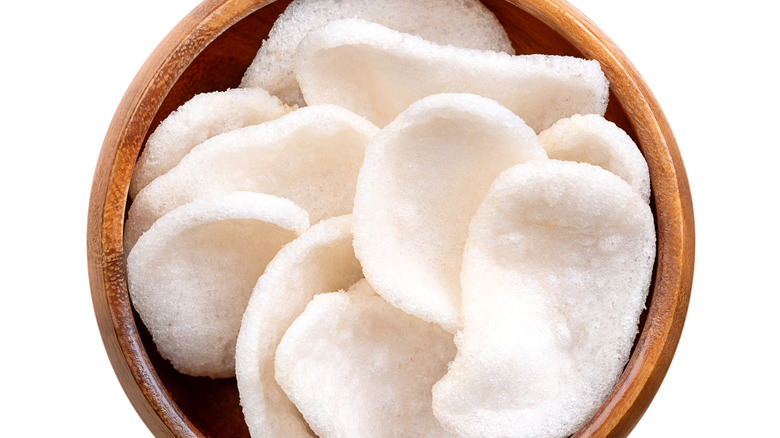
For the uninitiated American getting Chinese takeout in the U.K., there is a side that often comes with meals that may well baffle them. They might even mistake it for some kind of packing material. First off, it's very edible. Second, it's actually a common item stateside — just not so much in Chinese restaurants.
We're talking about puffy, crispety prawn crackers. Conventionally, they are made out of prawn paste, tapioca flour, and water before being dried out and quickly deep-fried. Whereas in the states the complimentary item in Chinese takeout is usually crispy noodles, in the U.K., it's prawn crackers.
There are even Americans who've tried prawn crackers that have declared the mildly fishy munchables their favorite Chinese offering in the U.K. As mentioned, they're not as unfamiliar to Yanks as you might think. Packaged shrimp chips are popular snacks in the U.S. The Asian import is sold at retailers everywhere, including Walmart and Costco. But it's the Brits who consider getting prawn crackers with their Chinese food order almost a birthright — and they're not happy when it doesn't happen.
Jar jow
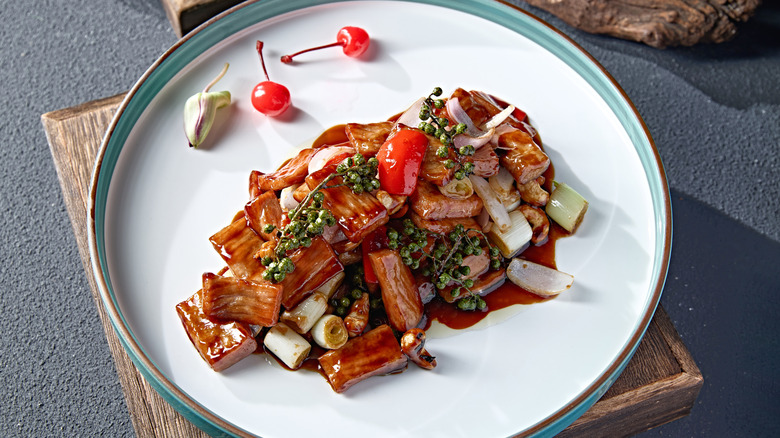
This is a dish that goes back to the very beginnings of modern Chinese food in England. And to this day, it's still a platter you rarely see outside of East London. Jar jow was the most popular dish at one of the first Chinese restaurants in the U.K.: Maxim's. The food was Cantonese, and this sweet-and-sour pork platter was an immediate hit — and set the standard for what Brits would consider Chinese food from there on out (even though it was only from one region of China).
How is jar jow made exactly? Slices of barbecue pork (known as char siu) are stir-fried in oil with bell peppers, onions, pork rinds, and bamboo shoots. A starch-thickened tomato-based sauce, sometimes with chili powder and additional seasonings added in, rounds out the dish.
As mentioned, jar jow has become a bit of a niche offering. It's taken a backseat to other dishes in recent decades: things like chop suey and chow mein (themselves increasingly less popular), crispy duck and pancakes, and a slew of other fare from provinces all around China. But jar jow still maintains its place as a Cockney stalwart.
Spice bag
Before you say anything: yes, Ireland is very much not Britain. Not only the Republic itself, but Northern Ireland as well (they're U.K.). Obviously, there exists an entire complex, contentious history that's far too big a subject for a single entry in a random food list. Just know the decision to place an Irish Chinese food dish alongside British Chinese food dishes is done with this wholly in mind.
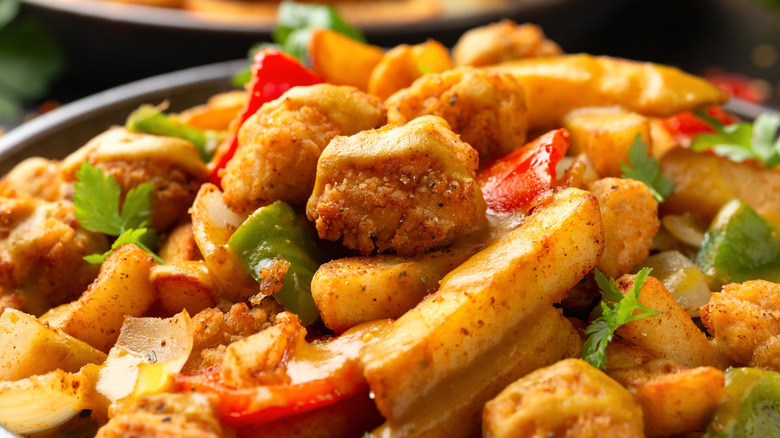
The dish in question? It's actually a bag. As in an actual bag. Spice bag, it's called. And it's a relatively new addition to the Chinese takeout landscape – credited to Sunflower Chinese Takeaway in Dublin, which apparently created the literal satchel of food in 2010. It's still an offering you'll find in the capital more than other spots in Ireland.
A great soaker-upper of Guinness (the supreme Irish kind of Guinness), it consists of bits of fried chicken, thick fries (chips), fried onions, and peppers, tossed with spicy seasoning in a paper bag and served with curry sauce on the side. Sometimes fresh chili peppers are thrown in for even more of a kick. It's all as insane and delicious as it sounds, as the spice bag was named the Emerald Isle's very favorite takeout dish in 2020.
British spring rolls
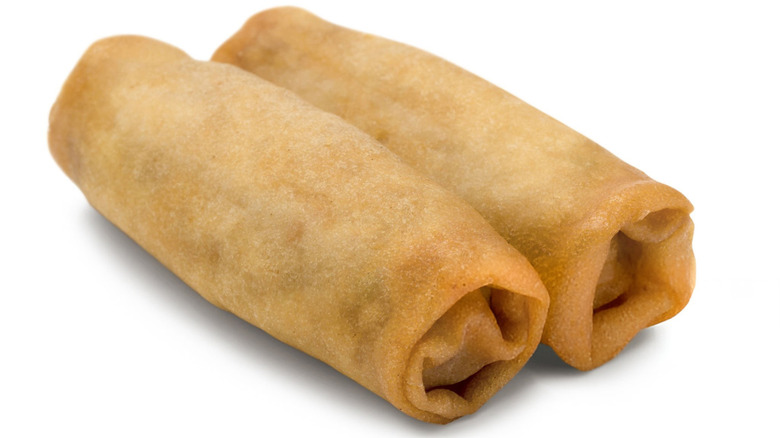
This is a dish that isn't as alien, odd, or bewildering to Americans as some others on this list. Instead, it's a variation on something diners in the U.S. would recognize: spring rolls. The spring roll folks in the States are used to are small, tightly rolled, fried wheat wraps (unlike the translucent Vietnamese rice paper wraps). They're filled with any number of ingredients, but usually pork, veggies, and/or mushrooms. It's usually lighter than many other kinds of Asian egg rolls, but it's definitely a more diminutive version of its cousin in the UK.
The British Chinese spring roll is also called a pancake roll. This gives a hint at its overall texture and size. As compared to American spring rolls, they're much larger and thicker, often filled with the same type of fare: veggies and meat. But they can look more like deep-fried sandwich wraps to American eyes, or even a crêpe.
The Brits like to get nuts with their spring rolls as well, filling them with nothing less than a full English breakfast. In case you need reminding, that's eggs, beans, tomato, bacon, sausage, and mushrooms stuffed into a parcel addressed to your gobsmacked, grateful belly. You don't have to be a Brit to enjoy that.
Chicken satay stir-fry
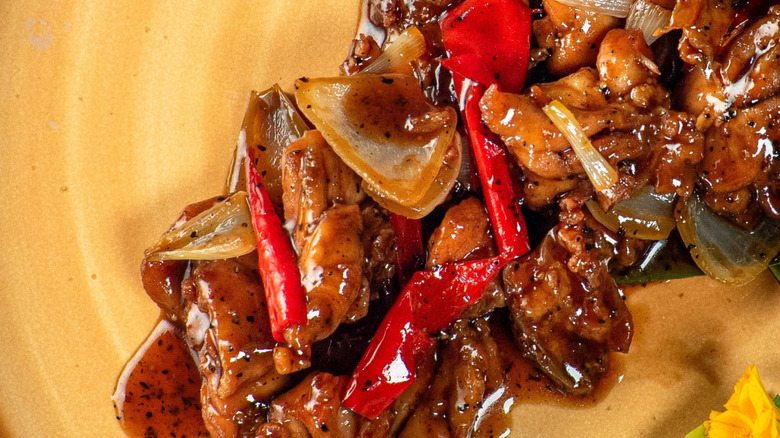
Chicken satay is a Southeast Asian original, co-opted by Chinese restaurants in both the U.K. and the U.S. But also, it's different in the U.K. and the U.S. And, also also, it's more popular in the U.K. than the U.S. There, that just about introduces it.
The satay seasoning differs from region to region in Southeast Asia, from Indonesia to Thailand. But generally it consists of some combination of sugar, coriander seed, turmeric, salt, coconut milk, fennel seed, cumin, garlic powder, lemongrass, ginger, and black pepper. This marinates the grilled chicken that's then skewered — which is the version Americans are accustomed to, if they know it at all.
The Brits' Chinese restaurants have a version that takes the chicken meat off the skewer and combines it in a stir-fry with peppers, spring onions, and peanuts. It can also be covered in a thick satay sauce – a version of the conventional sauce that has less peanut and coconut. A caveat: What it's missing as compared to the skewered version is something crucial: the drooled-over peanut dipping sauce.
Sesame prawn toast
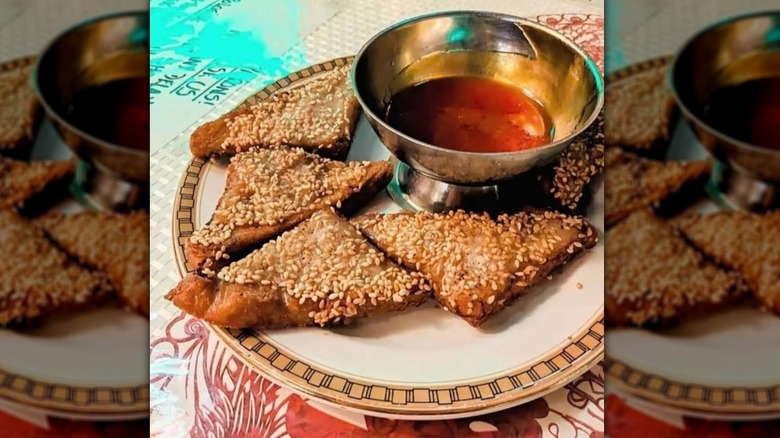
A classic Brit-Chinese starter that has yet to take off over the Western side of the pond, sesame prawn toast is a Hong Kong favorite that reflects the region's British colonization. In Hong Kong, however, it's considered a dish for special occasions (and thus made in a much more creative manner). But in England, the dish eventually became a cheap side. Delicious and craved, common.
No surprise that the Brits love it, though, considering it incorporates white bread. Prawn paste is spread on a triangular slice of that. Ginger, egg, garlic, soy, sugar, and, of course, prawn make up the paste, imbuing the appetizer with sharp, briny, sweet, and salty notes. It's then deep-fried and topped with sesame seeds.
As alluded to, it's a comestible that's deeply associated with Hong Kong. But is the dish actually Cantonese? It's been called a classic of that cuisine. Probably best to look at sesame prawn toast as born of the Canton region, but coming to fruition in the municipality of Hong Kong. Either way, Brits dig it; Americans don't know it.
Sweet-and-sour chicken balls
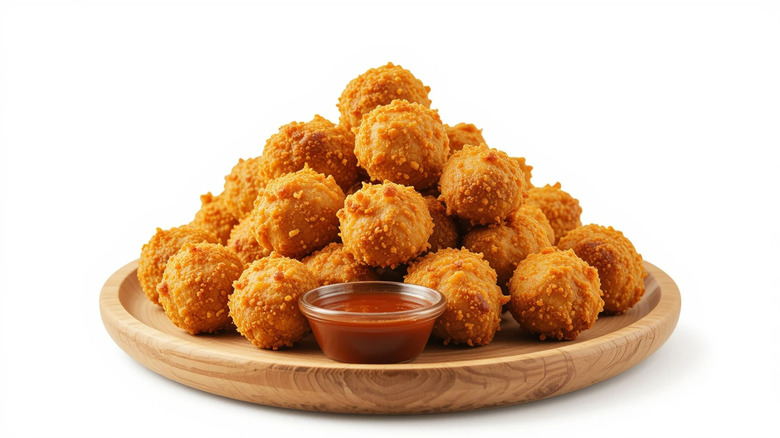
There are foods that aren't at all American that could totally be American. This is one of those foods. Sweet-and-sour chicken balls are – and I hope you're listening, America – deep-fried mini-orbs of chicken (either breast or thigh; the latter for more succulence) served with a sweet and sour sauce. If that doesn't whet the Yankee appetite, then what will?
A dish akin to this doesn't really appear on American Chinese menus either. Sure, things like sesame chicken and General Tso's chicken, with pieces that can often be ball-like, are ubiquitous — if they're not over-sauced. And sometimes a Chinese takeout place might have something approximating it on a kids' menu. But otherwise it's non-existent.
MSG, long villainized but redeemed in recent years, is said to be the key to the sweet and sour sauce that comes with – and is all-important to – said chicken balls. That's the umami flavor accompanying the other flavors, along with the buoyant crispiness of the meat. Umami = good. Fried chicken = good. Ball = good. Let's get on it, U.S.A.
Crispy chili beef
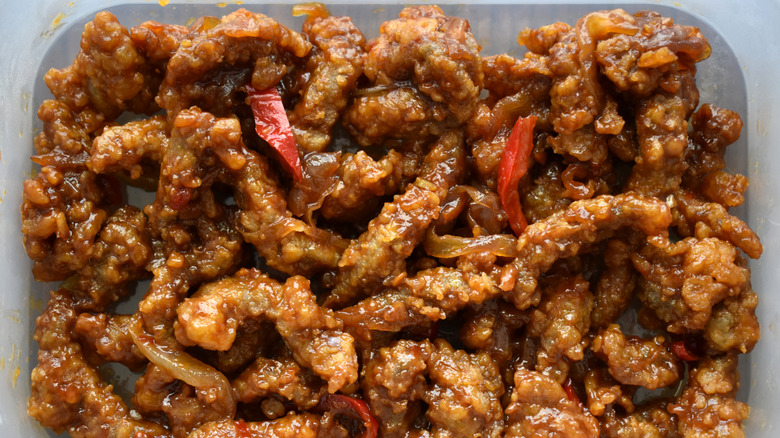
Crunchified beef with a saucy kick of spice would be a welcome addition to U.S. Chinese takeout. No surprise that it's a Chinese takeout go-to for Brits — despite some naming hiccups through apps like Uber Eats.
The steak itself is cut into thin strips and flash-fried, giving it that signature crunchy texture. The gingery sauce augmenting it is chock-full of ingredients and flavorings, including the aforementioned ginger, soy sauce, garlic, spring onions, red pepper, red chili, sweet chili sauce, five-spice, rice wine vinegar, and even ketchup. You can also serve it with cooked noodles or prawn crackers on the side, to complete the feast. What you get is a favorite takeout item for the average Brit, and a crispy, meaty, kick-in-the-face smorgasbord.
And in a country like the U.S., which loves its beef (the average American consumes almost 60 pounds of it a year), you would think that this would catch on. Even variations like honey garlic crispy beef seem to be candidates for mass American consumption. Maybe in time. For now, this Chinese dish is more at home in the British Isles.
British kung pao chicken
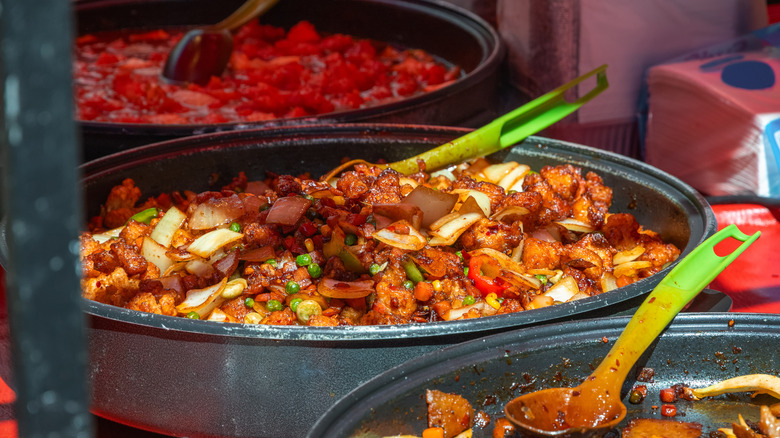
This is another Chinese dish that is simply a matter of variation in regard to the U.S. and the U.K. A classic takeout offering on both sides of the Atlantic. The meal itself derives from the Sichuan province, supposedly named after a Qing Dynasty governor, Gongbao. The U.K. version doesn't have all the additional veggies and things that are often found in the U.S., which is reflected in Jamie Oliver's homemade recipe.
But what is the kung pao sauce exactly? It's made up of oyster sauce, soy sauce, rice vinegar, sugar, corn flour, red chilis, spring onions, and peanuts. In the U.K. (and in and around China), this all stands on its own. But in the U.S., the dish can often get an addendum of zucchini, carrots, and celery.
This all fits with the American tendency to overstuff, overcompensate, overdo it – instead of trusting the simplified, authentic ingredients. Not that Brits are exemplary in this way either (see many of the above), but in this case, they stay much closer to the Real McCoy.
Chips in curry sauce
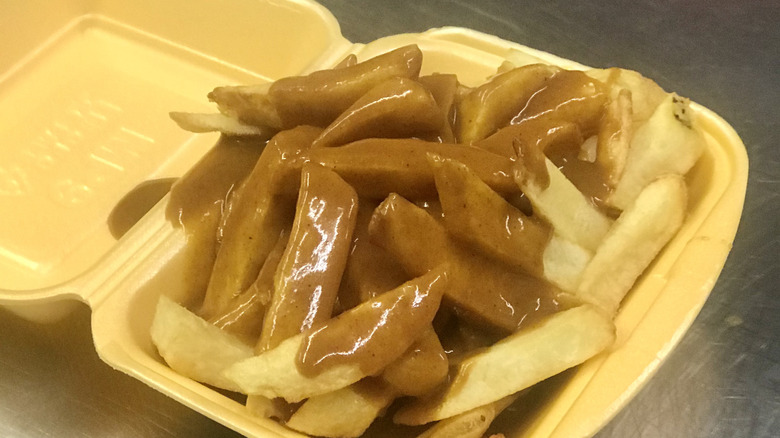
This is a perfect example of Chinese eateries not only offering adapted versions of their own authentic food, but also incorporating elements their local clientele loves, no matter where they're from. Curry sauce – very much a homespun take on the Indian original – combined with classic British chips is something that's so fundamental to U.K. eating that Chinese restaurants had to incorporate it. And they have, with gusto.
With India being a one-time jewel in the British Empire's crown, curry has a long history in England. So much so that the sauce has become as British (in Brits' eyes) as it is Indian. Many chip shops in the U.K. offer it, although the curry sauce is not exactly the same as authentic Indian curry. In fact, it can be vastly different. The British soldiers who were stationed in India during its colonization loved it, but came back home having no idea how to make it. So they took all the Indian spices they knew – coriander, cumin, and turmeric, among others – threw them together into a yellowed sauce, and there it was: Britain's very own beloved version. Can you blame Chinese places for taking advantage of that?