

How America's Oldest Cooking Show Made One Woman A Household Name
We may receive a commission on purchases made from links.
There's one star chef whose uniqueness defies all others — and that's because this chef isn't a real person. You know her, you love her: Betty Crocker. The story of this influential food mascot began In 1921, when the Washburn-Crosby Flour Company (now General Mills) published an advertisement for its Gold Medal Flour in the Saturday Evening Post with an accompanying promotion: All who submitted a correctly-constructed jigsaw puzzle would receive a keepsake pin cushion. Little did the company anticipate they would receive over 30,000 submissions, along with hundreds of letters containing questions about baking. To reply to each inquiry, they invented the fictitious Crocker, a personable, cheerful, and warm confidante with extraordinary kitchen skills.
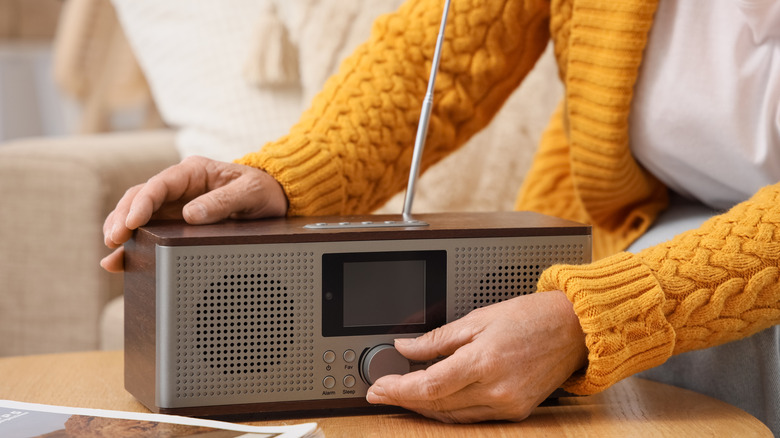
Crocker's "Dear Abby"-style approach quickly spanned past letters. In October 1924, the "Betty Crocker Home Service Program" debuted on Minneapolis radio, following shortly thereafter by the "Betty Crocker Cooking School of the Air." It became the country's first radio cooking show, offering listeners an opportunity to cook alongside Crocker herself. It quickly expanded to 13 regional stations in the next year, and by 1927, the show had been picked up by NBC and broadcast nationally. In its prime, the radio program was heard in one million households each week, and ran for 27 years, making it one of the longest-running and most successful radio shows in history. Blanche Ingersoll initially provided Crocker's voice for the Minneapolis shows, but it was home economist Majorie Child Husted who later performed the heavy lifting. She not only voiced Crocker on NBC but also wrote the scripts for the radio broadcasts, and led recipe testing, all contributing to Crocker's credibility and appeal.
How Betty Crocker's relevancy has spanned over 100 years across many media
By 1945, Betty Crocker was the second most famous woman in America and deemed the "First Lady of Food"; only real First Lady Eleanor Roosevelt outranked her in popularity. She was a tremendous resource to American families during the Great Depression and throughout World War II, when widespread access to quality food and options on how to cook it were limited. Crocker later hosted a radio program called "Our Nation's Rations," which helped homemakers capitalize on their reduced food supplies.
Crocker's radio success eventually translated to television, where actress Adelaide Hardy played the cooking maven on "The Betty Crocker Star Matinee." This was just one of many visual representations of the character: She had been previously brought to life in a 1926 portrait by artist Neysa McMein, who combined the facial features of Washburn-Crosby's female staff for her take on Crocker. Since then, Crocker has depicted on numerous occasions, all reflective of the times' cultural beauty standards.
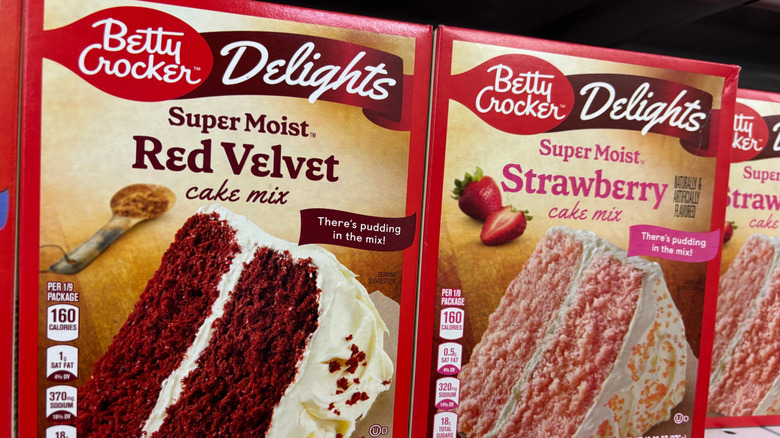
Today, Crocker's trademark red spoon remains a fixture on grocery store shelves; it debuted on a package of dried soup mix in 1941, and since then, has been featured on boxes of cakes, brownies, and other confectionery creations (that I enjoy baking with my mom). While you may not be able to cook alongside Crocker on TV or radio today, home chefs and bakers can still pull from Crocker's archival recipes in "Betty Crocker's Picture Cook Book," which has been a bestseller since 1950. BettyCrocker.com and Crocker's social media platforms are also full of thousands of red spoon recipes that are guaranteed to delight, and you can still "Ask Betty" for advice when your baking goes wrong via the site's searchable database.