

12 Things To Know Before You Dine At A Korean Restaurant
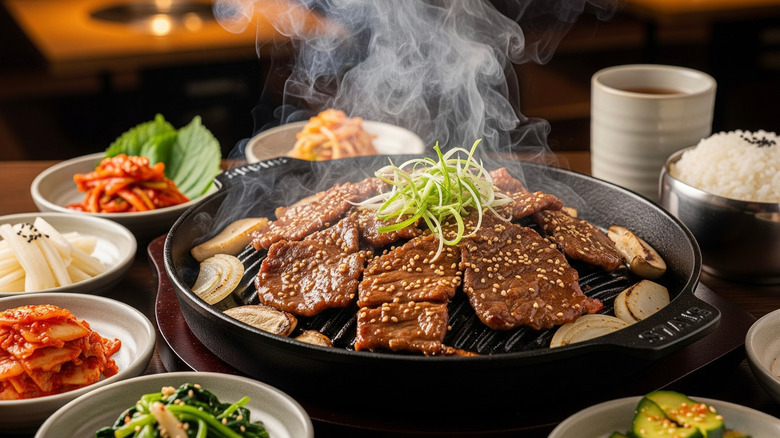
There's a reason why some people may get overwhelmed when dining at a Korean restaurant. No sooner than you are seated, and the table starts filling rapidly. Small dishes abound, forks and spoons are replaced with tongs and scissors, stews come bubbling hot, and dishes arrive waiting to be assembled. It's easy to wonder if you're doing something wrong. The truth is: you're not. We asked McKenna Lelah, executive chef at Lapaba restaurant in Koreatown, Los Angeles, to share some pro tips — and luckily, Korean dining is not about doing everything "right." Instead it's about staying present, paying attention, and enjoying the meal unfolding in front of you.
Attentiveness can go a long way when faced with a new cuisine or culture. Watching how others eat and drink, how dishes are served and shared, and when servers guide and instruct, can make all the difference between a good meal and an anxious dining experience. Additionally, curiosity is rewarded. Now is the time to try a new cut of meat, dip into an unusual sauce, or experiment with a new flavor combo. It's all part of the fun. All that is asked of you is to be open, be present, and trust the process.
How a Korean meal is paced
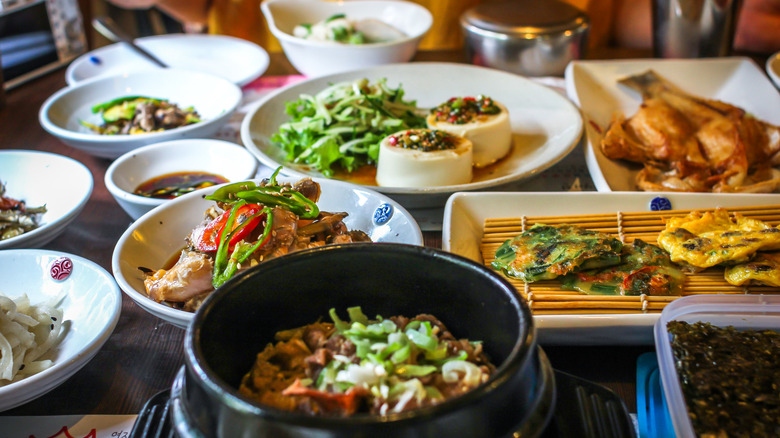
For a country that prioritzes rules, rituals, and respect, Korean meals don't follow a clearly defined parade of courses. Surprising to many, eating at a Korean restaurant turns out to be a more convivial affair than imagined. All meals are built around sharing. Dishes are brought to the table when they are ready and are meant to be eaten together rather than in strict sequence.
"Korean cuisine revolves heavily around sharing or family-style dining," chef McKenna Lelah explains. "Pacing-wise, it comes as it comes, nothing is over-thought." The first things to reach your table will be a spread of small side dishes, or banchan. And while we did say that Korean meals are generally relaxed, a few conventions do persist. For example, bowl placement is important if you want to stick to customs and avoid hurting any sentiment. Your rice bowl should sit to the left of your soup or stew.
Beyond that, how you eat is largely personal. You can go ahead and mix rice directly into your soup or alternate spoonfuls of broth with bites of rice. Both approaches are common, and neither is considered better than the other. Everything on the table is meant to be eaten together. The pace is unhurried, and combining flavors is given more attention than the order of eating.
Good banchan is a clue to the quality of the restaurant
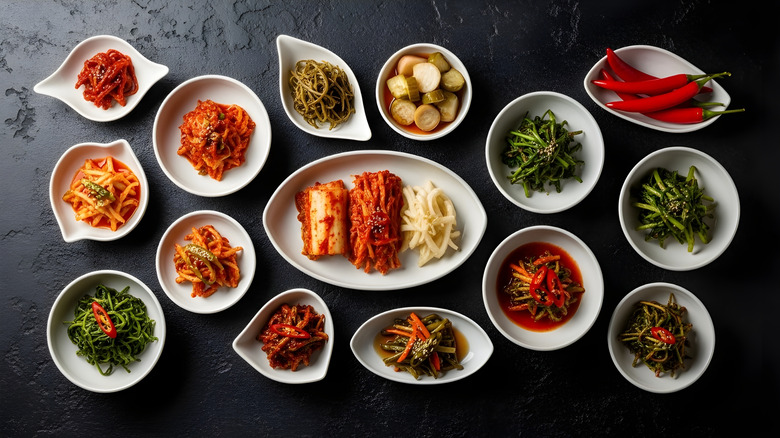
Once seated at your Korean restaurant of choice, don't be surprised when a barrage of tiny plates are set down on your table. You may not have ordered them, but they arrive nonetheless as an important part of the entire meal. "Banchan are small accompaniments to the main meal that are meant to be eaten with rice as well as with your main dishes to offer a break for your palate from eating the same dish for the entire meal," chef McKenna Lelah explains.
It's worth noting that these "small accompaniments" cover a wide range of dishes. They can be as small as a spoon of kimchi, or a tiny saucer of pickled vegetables; the whimsical steamed egg known as gyeran-jjim, or a dollop of creamy potato salad. All these work as ways to bring balance as the meal progresses. For example, a tiny mouthful of cool, vinegary cucumber against a slice of barbecued beef, or soft texture against crisp. A well-rounded banchan spread should include a mix of flavors and textures but still not overwhelm the table.
"Banchan shouldn't be an afterthought for the restaurant, there should be thought and care," reiterates chef Lelah. When these dishes feel generic or stale, it's often a sign that the restaurant kitchen is not that invested in the entire dining experience.
At a Korean BBQ each cut is treated differently
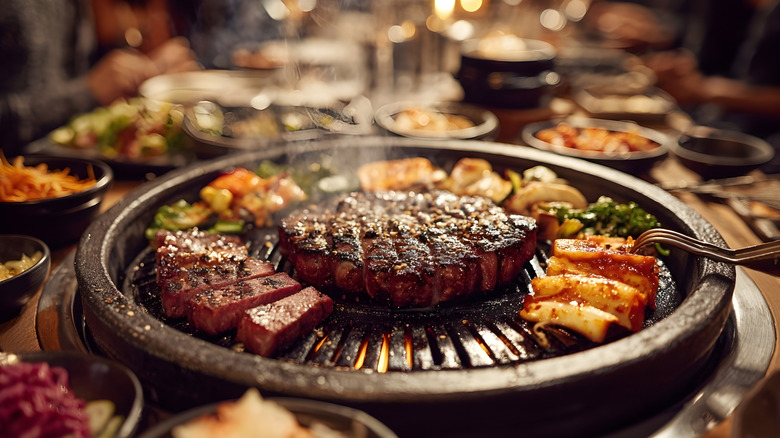
There's your typical traditional Korean restaurant and then there are the Korean BBQ spots. Thanks to popular K-drama shows, YouTube, and TikTok, suddenly everyone wants to reenact dinners replete with delicious freshly grilled meats and endless bottles of the ever-popular soju.
If you do find yourself seated in front of a sizzling tabletop grill and a dizzying array of marinated meats and side dishes, there is no need to panic. A Korean BBQ spot worth its salt will have staff handle the meat for you from start to finish. While there may be some casual restaurants that let guests do their own grilling, most Korean BBQs view turning the meat yourself as a sign of disrespect — almost implying that the serve staff are not doing their job.
The main reason for this, as chef McKenna Lelah points out, is that, "Each cut is cooked a specific way and it's best to let the server or restaurant guide your experience." Every piece of meat, whether it's marinated short rib or juicy chunks of pork belly, needs to be cooked with intention. Everything adds to the entire experience, from timing when to turn the meats on the grill to the order in which the cuts are cooked. Staff are trained to manage each tiny detail so that the meat served is always at its best.
Ssam is all about building the bite you want
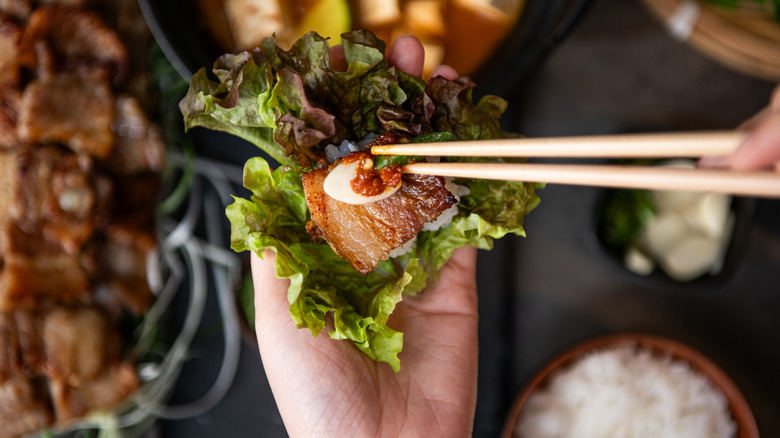
The simplest explanation for "ssam" would be "wrap". But it is so much more. "The idea is you create the bite you want to eat," chef McKenna Lelah explains, urging the curious diner to experiment with different fillings. To your leafy green (most often lettuce leaves), add a sliver or two of grilled meat, a little kimchi, and a little rice to round up things. Finally comes the ssamjang — a fermented, savory-sweet paste that brings everything together.
Beyond this basic combination, it all comes down to individual preferences. Don't worry about restraint or the perfect pairing. How much or how little you add is entirely up to you. Adding garlic slices, chili, or green pepper brings a depth and umami to each bite. Some people prefer minimalist wraps that consist of just meat and sauce rolled into the crunchy lettuce leaves. Others load up their ssam with every condiment around. Neither approach is considered better than the other. However, what IS expected is that ssam should be eaten in one single bite. Keep that in mind the next time you build your perfect mouthful.
Marinated meats don't need sauces
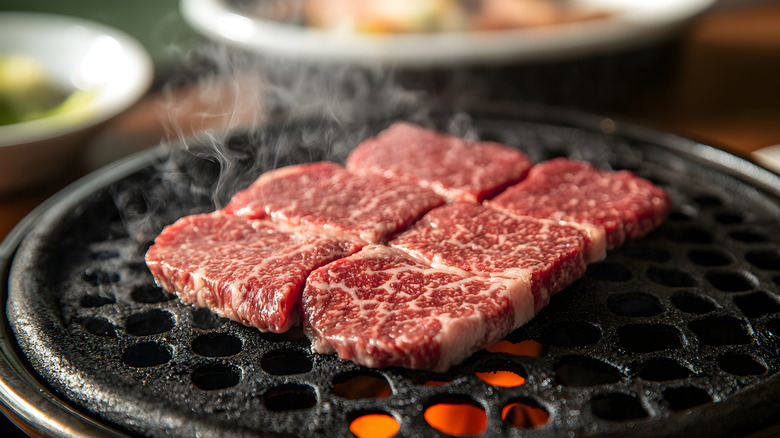
Apart from the banchan, you will also have a range of dipping sauces at your disposal. However, at a Korean BBQ, these sauces are not a default option – using them depends on how the meat has been prepared. McKenna Lelah puts it simply: "If the meat is marinated, you generally don't dip it in any of the sauces or seasonings." Several traditional recipes require softening or sweetening cuts of meat with honey or pear. Dishes like bulgogi call for meats that have been marinated with a number of spices and sauces before being cooked. As the meats caramelize on the grill, the flavors develop further and rarely require much more in terms of condiments to be enjoyed.
Unmarinated meats, on the other hand, are left alone so that their natural flavor and texture can shine. This is where you can experiment with the sauces served. Chef Lelah suggests "it is best to dip it in the Korean sea salt, sesame oil, and sweet soy," if the meat isn't marinated. This will not overpower the meat and add contrast where needed. Other popular options include ssamjang, the thick fermented paste often used with dishes heavy on the rice and fresh greens. This offers a bold and salty anchor to each mouthful. Once you tune into the logic of the Korean dining experience, the table starts to make a whole lot more sense.
Korean food is more balanced than spicy
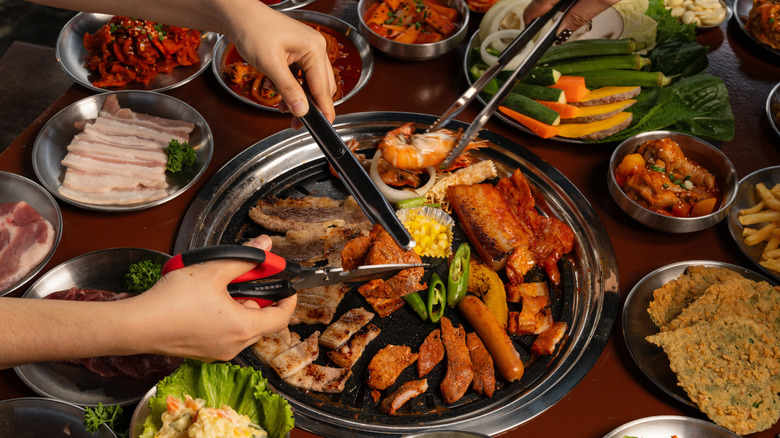
There's a big difference between "spicy" and "flavorful." One implies heat, and the other a more complex layering of tastes and textures. Korean food may seem "spicy" but in reality, this reputation is erroneous. "Korean food has spice, but we wouldn't say it is inherently spicy," McKenna Lelah points out. "Korean food is balanced with a lot of sugar, so savory dishes usually lean more sweet with a hint of spice." Sugar, fermented pastes, and even fruit are frequently used to round out heat, creating dishes that feel deep and comforting rather than fiery.
Korean meals are designed to be a mix and match of bites and spoonfuls from different dishes. Ideally, there shouldn't be one single, dominant flavor. When you start eating (and enjoying) dishes from across the table and moving between dishes, you begin to understand the bigger picture of how the meal works.
That balance becomes clearer when you stop isolating dishes and start eating across the table. Korean meals are designed to be experienced as a whole, not as a single dominant flavor. There's usually something spicy, something sweet, something mild, and plenty in between, all meant to interact. The pleasure comes from that movement. A little word of warning here — hoarding a single dish and not sharing is frowned upon and breaks the shared nature of the entire meal so, if you love a dish that much, maybe order it as a takeaway to binge alone later!
Korean BBQ is a dining experience, not a show
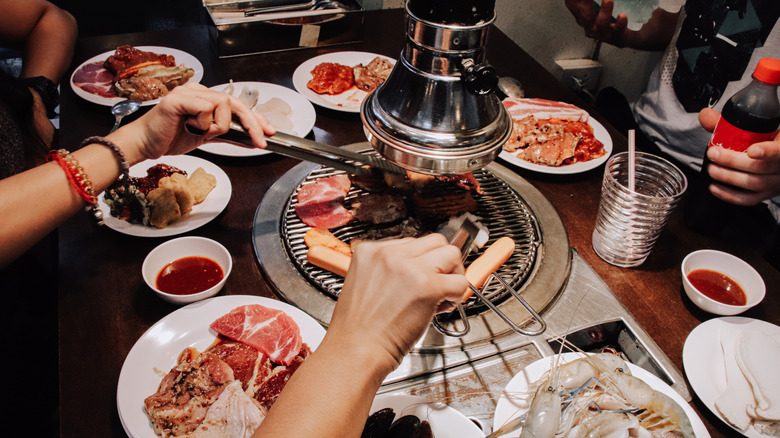
Walk into a Korean BBQ and its easy to get caught up in the drama of the occasion. From the steaming tabletop grill to the steady procession of meat to your table, many end of treating the experience like a show to be watched. "There are diners who treat Korean BBQ like a party or a show, similar to Benihana, and that is truly not the case," notes chef McKenna Lelah. "Korean BBQ should be experienced as a civilized meal, like any other restaurant, whether French, Italian, etc."
The grill isn't there to entertain. Rather it is a means to enjoy the food served at its best. Historically known as gogi-gui, Korean BBQ has evolved into a deeply social way of eating, with the focus always on sharing and conversation. As the meal unfolds, diners are encouraged to slow down and pay attention and nothing is meant to be rushed or to overwhelm.
Even when the staff handle the grilling, the reason is to watch and then respond. It's never about getting the first bite perfect — instead, discovering what works together, over the course of the meal, is the entire point. Treating Korean BBQ as a "dinner and a show" does grave injustice to an inherently collaborative experience.
Metal chopsticks can take getting used to
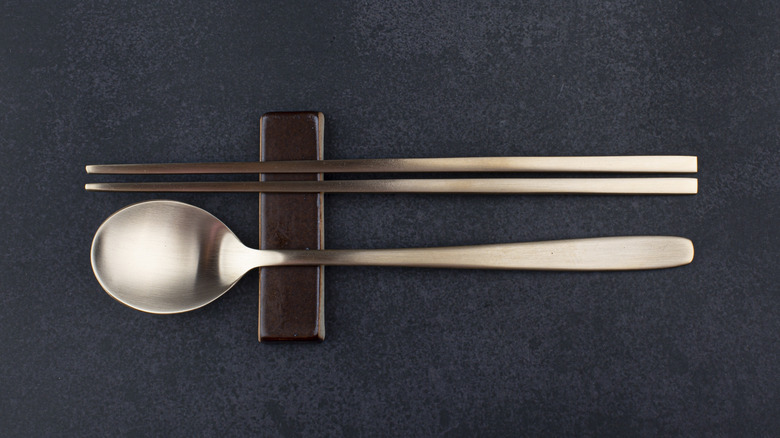
Eating a new cuisine demands that you learn to eat with the appropriate utensils. For some styles of cooking, hand eaten is the best alternative. For others, a wide shallow spoon is the first choice for soups and curries. Asian cuisine uses chopsticks, but not all chopsticks are created equally. In Korean dining, chopsticks are flatter, smoother, and usually made of metal. This might feel intimidating to use at first being smoother and with less traction.
All this means is that more attention needs to be paid to eating. Much like the complete Korean dining experience, using metal chopsticks forces you to slow down and eat more deliberately. You will also notice that metal chopsticks (all types of chopsticks, actually) are treated with care. It would be polite to remember never to place the food end of the chopsticks on the table. Placing the chopsticks pointed upwards in a rice bowl or placing them across the top of some dishes is usually associated with funeral rites, so best avoided.
There are a few schools of thought about why Korean chopsticks are metal in the first place. Some believe that metal utensils reacted immediately to toxins and during the Joseon dynasty were used to protect nobility from poisoning. Others feels that metal is more hygienic and can be sterlized effectively with boiling water. The third theory is that scarcity during the Korean war, forced people to repurpose scrap tin cans into lightweight utensils.
Drinking etiquette only really matters with elders
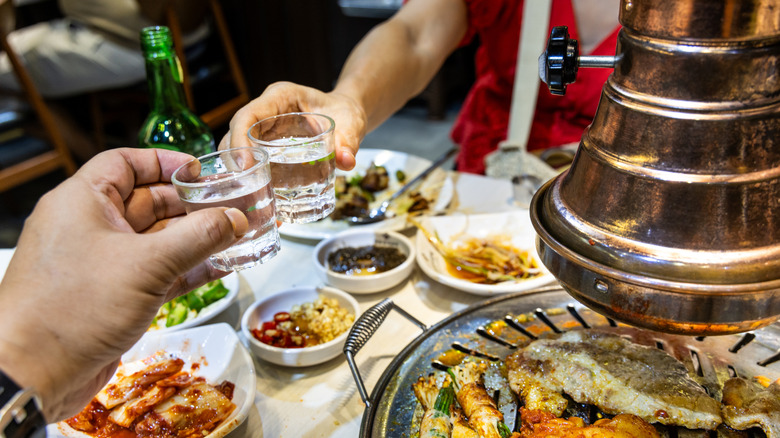
When it comes to drinking at a Korean meal, there is no need to fear any elaborate set of rules and rituals. "Unless you are drinking with an older Korean person, there is no etiquette," chef McKenna Lelah notes. That said, when elders are present, certain manners do need to be met. "If you are eating or drinking with an older Korean, you must pour their drink first and always drink facing to the right or left, never directly facing them," advises Lelah. This is more a gesture of respect, rather than formality for formality's sake.
Now, if you are invited to a traditional meal or to a family gathering, things can get a little more nuanced. No need to overstress, but just keep these simple guidelines in mind. Ideally, cups are never left empty, and the very act of refilling glasses is a shared responsibility. What this means is that if you notice your glass is running low, it is your neighbor's responsibility to top it up. You may subtly indicate your need by topping up their glass.
At some celebrations, glasses move around the table as part of a coordinated toast: You drink what's passed to you, refill, and pass it to your neighbor on the right, continuing a happy cycle that keeps everyone involved. These small ceremonies emphasize connection and consideration, much like most other Korean rituals.
Why is there a pair of scissors on my table?
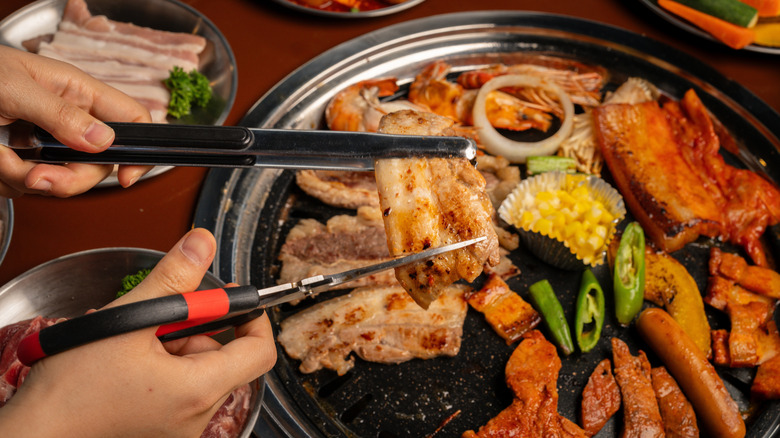
You may have sat down at a Korean BBQ and been taken aback at the sight of a pair of scissors next to the tongs and chopsticks. The explanation for its presence is simple and practical. Unlike other cuisines that value knives, Korean food relies on scissors to quickly cut large pieces of meat on the grill. Once these bite-sized portions are cut they continue to cook even faster and are ideal for building a delicious ssam.
Once you get into using these shears, there's a certain childlike glee that comes from snipping a slice of meat mid-sizzle. The precision and the immediate reward of a perfectly sized bite makes every meal all the more enjoyable. Modern Korean restaurants sanitize these scissors like any other utensil, so hygiene isn't a concern.
Scissors aren't just for meat, either. Part of the efficient and unpretentious Korean approach to dining, scissors are used to shorten long strands of noodles or large chunks of kimchi into more manageable bites. Unlike cultures that may have superstitions or strict table norms around cutting food, Koreans embrace practicality.
Korean table manners hit differently
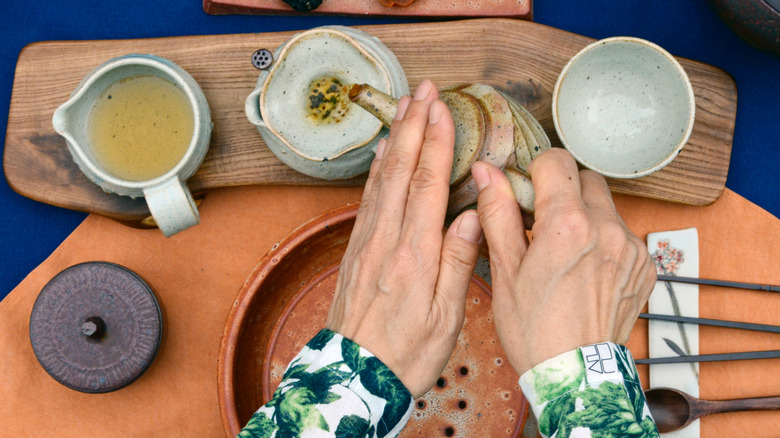
It's easy to get overwhelmed with customs and rituals when faced with a new cuisine and culture. The last thing one wants to do is offend anyone or be impolite — so we asked McKenna Lelah if there is anything that people should avoid doing when dining at Korean restaurant. "No," the chef told us. "As long as you are nice and respectful, it never hurts to ask politely" when requesting refills, substitutions, or adjustments.
While Korean table manners might seem a bit more formal than you are used to, behind every polite nod or cheerful refill of your cup is the feeling of respect. Shared dishes are the heart of the meal, so it's important to approach them thoughtfully. Always use chopsticks for side dishes but a spoon for rice or soup. Do not begin eating until the oldest person at your table starts. And avoid digging directly into shared plates. Small gestures, like using both hands when passing food or pouring drinks, signal appreciation to those around you.
Needless to say, this politeness extends to interactions with the staff, as well. Saying gamsahamnida or thank you after receiving service will be met with smiles. Many Korean restaurants require payment at the counter rather than at the table — all part of the efficient process. Approached with respect and curiosity, these little nuances can enhance your meal and deepen your connection to the food you are feasting on.
If you're ordering one dish, make it kimchi jjigae
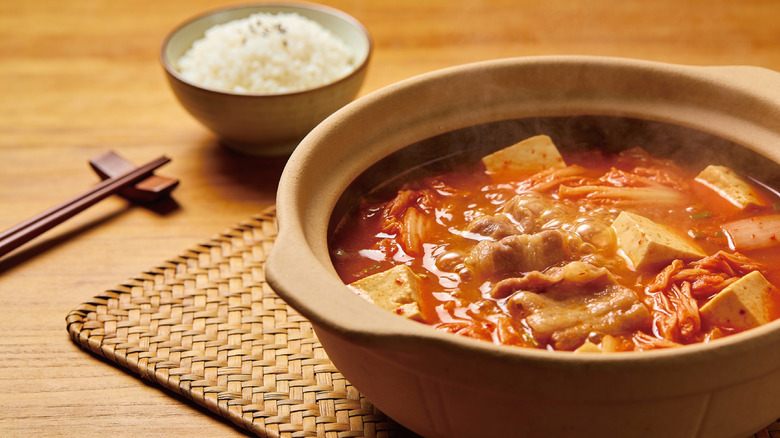
When it comes to picking a single dish to try at a Korean restaurant, chef McKenna Lelah doesn't hesitate: "Always order kimchi jjigae (kimchi stew, usually with pork and tofu). Nothing to avoid, go for it!" Often considered a cornerstone of Korean cuisine, this spicy, tangy stew offers a wonderful combination of tastes and textures; the funk of the kimchi matches the richness of the meat. The steamed, fluffy rice, in turn, offers the perfect foil for the soft, cooling tofu. All in all, this is an ideal dish for first-timers who want a quintessential Korean experience.
Korean dining is all about sharing and variety, as well as an extraordinary level of care and attention to every facet of a dish. Traditional dishes like bibimbap show the care and presentation Koreans put into everyday meals. Consisting of rice topped with assorted vegetables, pickled radish, mushrooms, and sometimes raw beef or egg yolk, bibimbap is the complete package for the adventurous diner.
At Korean BBQ or larger restaurants, ordering more than enough food for the group is essential. Even solo diners should consider two orders of meat or dishes, and groups usually order one less than the total number of people, ensuring everyone has enough — especially when it comes to sharing plates around. Never be afraid to ask your server for help with ordering food and drinks for the table. Servers are used to guiding diners through these norms and are happy to be included in the process.