

What You Need To Know About Starbucks' 4 Minute Rule
Don't you miss the good old days? I certainly do, especially when it comes to my customer experience at Starbucks. The classic era of Starbucks had a tangible je ne sais quoi that was unique to the coffee conglomerate, and chairman and CEO, Brian Niccol, wants to bring this back. (Is it too soon for a "Make Starbucks Great Again" joke?) Shortly after assuming the role in fall 2024, Niccol announced his "Back to Starbucks" campaign, designed to streamline the Starbucks experience — most notably, to answer Starbucks' desperate need for speed by shrinking exhausting wait times. The campaign pledged to require no more than a four-minute wait from when you order your drink to when it's in your hand.
The number four was chosen with intention. Niccol claims this was done based on customer and barista expectations, while taking into account the previous capabilities of staff before the company's popularity skyrocketed. As of fall 2024, roughly half of Starbucks' orders were executed in four minutes or less. To garner the other half, Starbucks has made gradual changes to its menu and customizations. Starbucks stopped charging for dairy substitutions due to growing trends in plant-based milk and curbed other custom features, forcing those who go overboard to simplify their orders. Additionally, Starbucks removed complex menu items – such as Oleato olive oil and coffee beverages – to improve efficiency. Starbucks also invested in faster machinery and reintroduced the self-serve condiment bar, which was discontinued during the pandemic.
Perhaps most vital to overall success, the company vowed to increase employee hours, staffing, and compensation in order to achieve the four-minutes-or-less mark. However, some employees claim Starbucks is acting in bad faith.
Employees aren't picking up what Starbucks is putting down
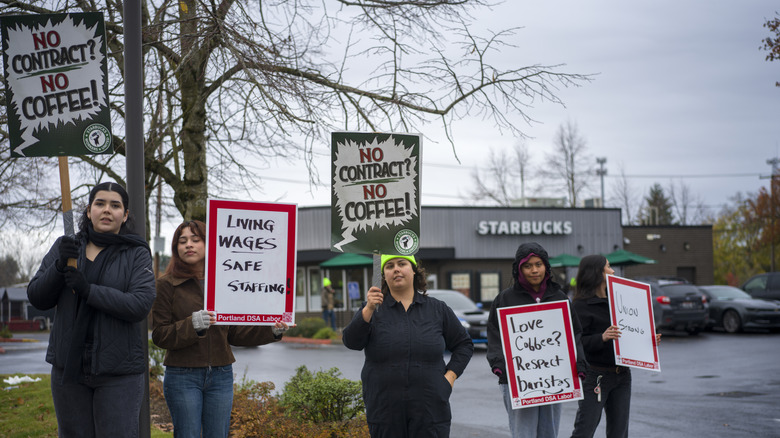
As Starbucks employees strive to re-enter the coffee company's golden era, some don't believe the ends justify the means. Starbucks employees claim that stores are severely understaffed and workers are underpaid, making the four-minute window impossible to achieve. On Reddit, when the "Back to Starbucks" campaign was introduced, one Starbucks employee noted, "It genuinely seems like they're just asking us to work faster ... We already do our best." Another stated, "Why did they promise us that most stores would be getting an additional 100 hours of labor, but in my store we have seen a dramatic decrease in hours overall from week to week?"
About 11,000 employees across 550 Starbucks locations belong to Starbucks Workers United (SBWU), a union that began organizing in 2021. The union has filed more than 1,000 unfair labor practice (ULP) charges against Starbucks, including more than 100 in 2025. As Diego Franco — a six-year Starbucks barista, and an elected strike captain and bargaining delegate for SBWU — claimed in an opinion piece for USA Today, "Niccol likes to tout his 'Back to Starbucks' plan, but he won't be successful without recognizing that the company's future depends on the baristas behind the counter."
On November 13, 2025, more than 1,000 union baristas went on strike to protest Starbucks ULPs; coining the strike the "Red Cup Rebellion," inspired by Starbucks' red holiday cups. While many have since walked off the strike, some union members continue to protest. As of early 2026, there has yet to be an agreement made between Starbucks and SBWU.