

Why Mechanically Separated Beef Was Banned In America
Banning different kinds of meat is somewhat common in the U.S., and it usually stems from two things: cultural norms or human safety. Mechanically separated meat definitely falls into the latter category, since chicken nuggets and various pork products are made via mechanical separation — meat goo, anyone? So why is mechanically separated beef banned? It all has to do with Bovine Spongiform Encephalopathy (BSE for short) — more commonly known as Mad Cow Disease.
For those who don't know, BSE is caused by a prion, which is a misshapen protein in the brain that begins to clump together with other proteins, which in turn misshape those proteins. In cattle, the proteins can no longer function, and the animals die. This prion can actually pass from one organism to another, so it is possible for the misshapen prion to jump from cows to humans via meat consumption only (it is not contagious in the everyday sense), or by eating brain and spine tissue — if that's your thing.
In humans, it's called variant Creutzfeldt-Jakob disease (vCJD). It rapidly becomes a neurodegenerative disorder, often mimicking extreme forms of dementia. There are other types of vCJD, but they are uncommon. Since the disease could be contracted through meat, it quickly escalated into an international scandal.
Preventing BSE is a great thing, but the panic was wildly overstated
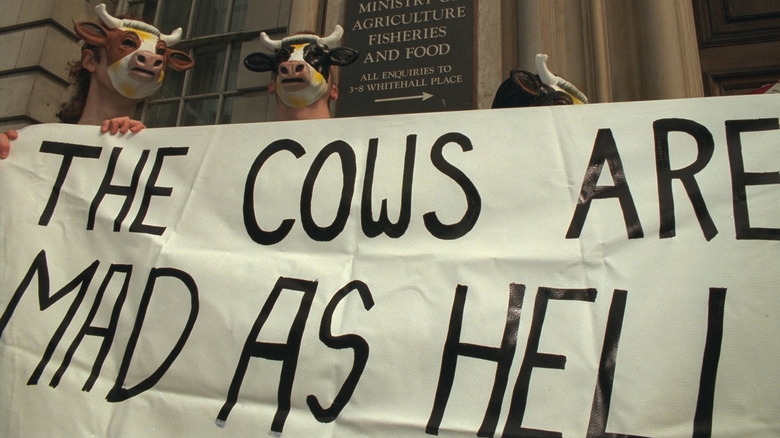
While BSE had been known since the late 1980s, it had mostly been centered on ranches and farms in the U.K. and seemed to be passed on when cows were fed discarded parts from other animals. By the early 2000s, Japan and the U.S. had cattle that tested positive for BSE. While infections still continue to this day, it is extremely rare for humans to get it. Only 143 people in Britain were diagnosed with vCJD.
To the surprise of many, especially today, the U.S. implemented several changes to how meat and cattle are regulated. The idea of the U.S. proactively regulating something seems like a bygone era. For example, cows that move across state lines have to be traceable for BSE. The ban on mechanically separated meat took effect in 2004, along with a ban on the consumption of cow brains, tonsils, eyes, and spinal cords. This is all, arguably, a good thing. So then why would I claim it was way overblown?
According to the CDC, only four cases of vCJD have been reported in the United States. Evidence suggests all four individuals were exposed abroad, with two cases likely linked to the U.K.Public concern created the impression that eating any beef could lead to brain degeneration. In reality, only four cases were confirmed among more than 300 million people in the United States. The widespread fear likely stemmed from the unsettling fact that a single misfolded protein could cause such severe neurological damage.