

The Key Differences Between Marmite And Vegemite

If you've walked by the international food aisle of your local grocery store, you may have spotted two small brown cans with yellow lids, often set side by side. One is called Marmite, while the other is called Vegemite, and both are yeast extract spreads. Maybe you've even been curious enough to try one of them, only to find the taste... overwhelming. Both have an intense, salty, yeasty flavor, and both usually get a sneer of disgust from Americans who haven't grown up with them. Given this, you might think they are basically the same product with different labels. Fans of one or the other are quick to tell you how untrue that really is.
It might surprise you to learn that yeast spreads are some of the most popular condiments in the world. Several countries have their own variation of yeast spreads, with Marmite and Vegemite both representing their own individual countries. Each uses slightly different ingredients and has a slightly different consistency that sets them apart from one another. You may even find that Marmite and Vegemite vary in taste by what country they are sold in. But where do the biggest differences actually lie?
Marmite is the original yeast spread

As an initial difference, Marmite preceded Vegemite by about 20 years. First sold in 1902 in Staffordshire, England, Marmite consists of a salty yeast extract that is a by-product of making beer. It contains tons of sodium, along with barley, rye, and oats. Although that may sound a little gross, the shelf-stable spread is high in vitamin B12 and protein, and has been a part of English breakfast routines for over 100 years. Brits like to put butter or marmalade on bread, then put a very small amount of Marmite on top as extra flavoring.
Marmite is a very divisive condiment in the United States, but that doesn't mean it isn't wildly popular on its home turf. In England, Marmite is one of the most used condiments, and it's versatile. It can be stirred into hot drinks, added to stews, and used as a flavoring for potato chips. It is also often used for seasoning in certain Asian countries, such as Malaysia. Even in Britain, it still has its fair share of haters, leading to the company using "You either love it or hate it" as a marketing hook for many years.
Vegemite comes from a land down under
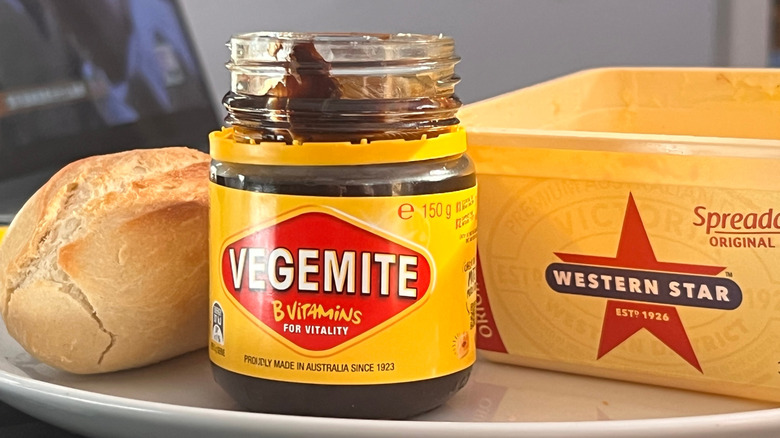
Arriving a little later in 1923, it's hard to deny that Australian Vegemite took inspiration from Marmite. Like Marmite, Vegemite is a yeast-based spread commonly used as a breakfast staple. It is also vegan, also a thick, brownish paste, and also has a dubious reputation in the United States. However, even just taking a spoonful out of the jar tells you that these are different products. The color is darker and the texture is much thicker, similar to peanut butter. Vegemite comes from barley and wheat, leaving out the rye and oats, and contains more Vitamin B. Consumers say it has a much stronger yeast flavor and lacks the sweetness lingering in Marmite. This may be because it uses onions and other vegetables in production, whereas Marmite doesn't.
Not only is it used as a breakfast condiment, but it's an unexpected Australian ingredient in chili and other dishes thanks to its umami tang. While either of these condiments partner well with toast or crackers, they are different enough that people have strong loyalties to specific ones, regardless of their birth country. If you like these spreads, consider giving the Swiss version, Cenovis, a try, or sample Australia's other yeast extract, Promite. If you simply can't stand these salty spreads, then that's okay — more for the rest of us!