

Cornish Hens Are Perfect For Small Christmas Eve Gatherings — Here's How To Serve Them
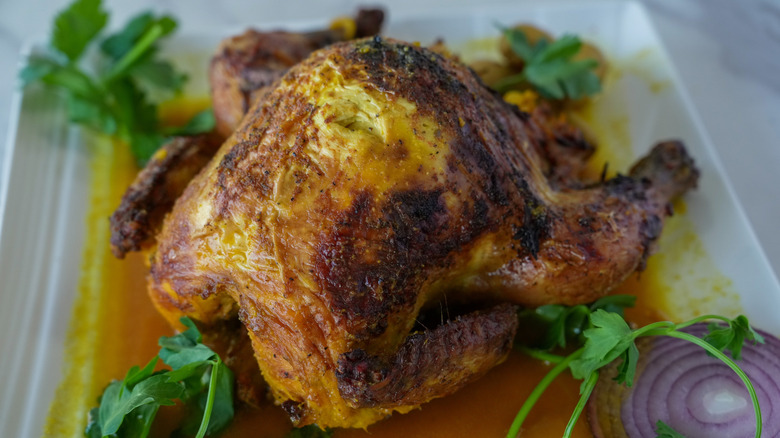
Is it still the holidays if you don't roast an enormous turkey? I often cook holiday dinners for just one or two people and still usually roast a full-sized bird, because I'm a sucker for any kind of meat I can buy for under $1 a pound. (Yay, pre-holiday sales!) However, if penny pinching isn't your primary concern, Tyson Foods culinary senior director Thomas Wenrich suggests serving a Cornish hen for smaller gatherings. This holds true whether it's for a Christmas Eve dinner or any other occasion when turkey is traditional.
"Turkeys can be a huge investment for holiday meals, and [they are] something that takes up a lot of refrigerator and oven real estate, especially if you are only cooking for a small crowd," explains Wenrich. "Cornish hens will thaw and cook faster than a turkey, while still delivering that carved bird experience around the holiday table," He adds that they can be prepared in many of the same ways as a larger chicken — deep-fried, spatchcocked, and grilled, among others. But in his opinion, there's one way to get the most out of your Cornish hen. "For the holiday spread, we always recommend a traditional roasted hen that can be carved or split to portion," advises Wenrich. "The Cornish hen offers the perfect roast chicken experience where all your guests can get the cut they want, with both crispy skin and succulent meat."
Cornish hens needn't be saved for special meals, though. As Wenrich explains, "There are so many ways to experiment with Cornish hens outside the traditional holiday season, making them a delicious and portion-right option throughout the year." As a bonus, Cornish hens are much more convenient in size than turkeys if you plan to use them for bowling.
Yes, you can still stuff a Cornish hen
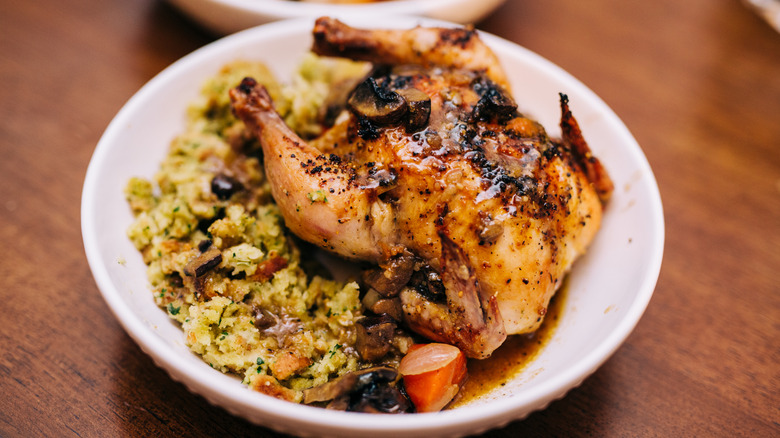
Cornish hens can be stuffed just like turkeys, although a safer option might be to cook the stuffing on the side (which technically makes it dressing). If you do want to bake it inside the hen, Thomas Wenrich offers the following safety tip: "Always be sure that your stuffing is cooked until 165 degrees Fahrenheit before serving." Anything that comes into contact with raw poultry needs to be heated to kill off the bacteria; otherwise, Grinchy gastric distress might ruin your Christmas. When it comes to stuffing, Wenrich has his preference: "The stuffing is best cooked outside the bird ... to create [a] contrast of crispy edges and soft and creamy interior." And if you want it flavored with the essence of turkey, you can always wait until the meat is cooked, and then squirt some juice over the stuffing with a rubber bulb baster.
As for what kind of stuffing best suits a Cornish hen, Wenrich tells us, "Any kind of traditional stuffing can be used, [such as] cornbread and cranberries, rye croutons and sausage, or a traditional country stuffing." (Boxed stuffing is fine, too, but it's better if you swap out the water for broth.) He also advises that if you cook the stuffing on the side, don't leave the chicken's cavity empty. "Try roasting the Cornish hen stuffed with a bounty of aromatics and herbs like garlic and bunches of sage. This brings phenomenal aromas to the bird and your kitchen," he suggests.