

The Pro Tips You Need Before Attempting To Move A Frosted Cake For Serving
We may receive a commission on purchases made from links.
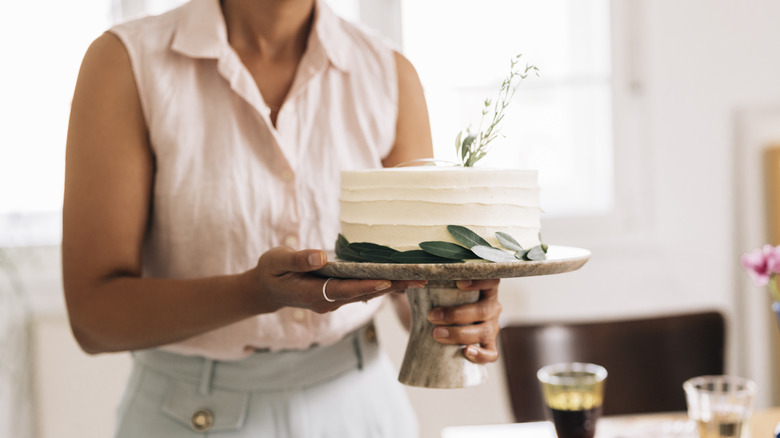
Even the most confident at-home bakers are often intimidated by the final boss of a great cake –- frosting. From working out the perfect frosting-to-cake ratio to parsing the difference between icing, frosting, and glaze (we won't tell anyone if you give up on this bit and turn to the best store-bought frostings) to actually piping that buttercream, making an elaborate, decorated cake is as much a construction project as it is a baking project. And then there's the moment of truth when you have to move your lovingly built creation to the table for serving. If you haven't prepared, the whole thing can come tumbling down. We reached out to Victoria Fisk, co-founder and confectionery chef at Bouqedibles where she lives and breathes intricate frosting florals and baked goods worthy of a spot in the Louvre, to ask for her big-hitter tips for moving a frosted cake.
From the get-go, Fisk's advice is humbling. "I build the cake directly on a cake board," she says. "I remove the parchment paper from the bottom layer before assembling the cake to avoid handling it later since that adds unnecessary risk." While this is logical once you've heard it, I think it's an "oh, duh" moment for many of us who have struggled to scrape a heavy fruitcake from a cutting board onto a presentation plate or attempted to edge parchment paper out from under a multi-tier monster once it's stuck there with icing. Of course, building and decorating a cake on serveware doesn't always mean you won't have to move it, but it does offer a sturdy, reliable base.
Building a sturdy, iced cake and dealing with small mishaps
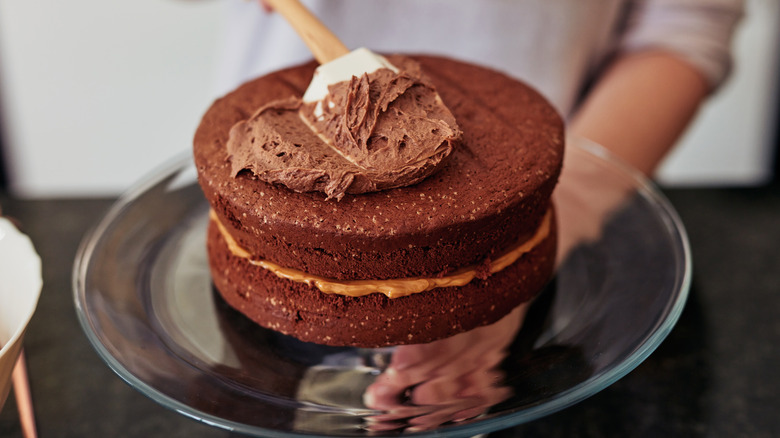
When Fisk suggests using our cake board or platter as a base when we're building our frosted presentation piece, she's telling us we need to think a few steps ahead. Another way to do this is to make your cake as sturdy as it is delicious. There are many ways to do this, but the easiest to manage at home involves making sure your cake layers are evenly cut and cooling your cake before frosting it. Starting your decoration with a crumb coating will also create an even, sturdy base layer that should help hold your creation together.
Fisk also had some ideas on how to deal with any icing issues stemming from moving a cake. A common issue is the join between the cake and the platter it sits on. As it's a point of movement, frosting in this area can crack while a cake is being moved. To deal with this, Fisk likes to "add a decorative line to cover the bottom or frost it so the bottom edge is covered."
Once you've moved your cake to its serving location, you can add any last minute decorations and carry out touch-ups. In addition to the decorative line, Fisk will "add elements around the bottom to cover any imperfections." Build this into your plan by bringing along extras of any cake decorations you have as well as packing your piping bags so you can refinish that piping or frosting along the bottom edge if need be.
Boxing and moving your cake without disaster
Moving a decorated cake from the kitchen to the dining room should be simple if you built it on serveware. Just slide it from the work surface, applying pressure to the board or plate it's on rather than the cake itself, carry it carefully, and repeat that flat sliding motion in the opposite direction to get it onto the table.
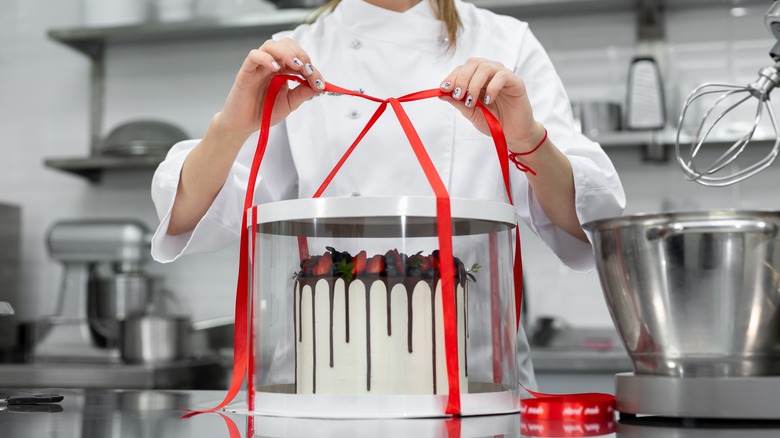
Sometimes a cake has to make a journey to a second location. For a frosted cake you have to transport to an event, Fisk suggests boxing up your iced masterpiece along with the platter it was built on. You can often find cake boxes and sturdy cake boards sold together, which helps to ensure they're correctly sized.
Fisk also reminds us not to be too proud to ask for help. Moving an iced cake can sometimes be a two-person job, particularly if it has multiple tiers or you've chosen to build it on a substantial serving platter or a raised cake stand. "If you have a huge cake that is heavy, the second person could be handy to carry the foundation it is built on," says Fisk. This means one of you should take the weight of that serveware while the other supports the cake itself. It will probably be a slow, careful operation with communication needed, so choose your cake-carrying buddy carefully.