

The Key Ingredient You Won't Find In Store-Bought Kimchi
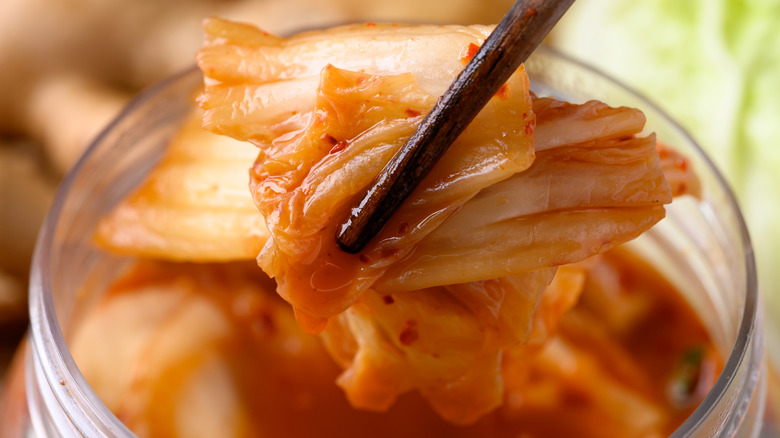
Kimchi may have its fans and detractors, but there's nothing quite like its earthy, tart spiciness. While it's gaining momentum in the United States, it's so in demand in other parts of the world that South Korea's kimchi shortage in 2020 sent cabbage prices soaring. Luckily, you can buy kimchi in stores stateside, but there's an important ingredient that packaged brands are probably missing. This ingredient is known in Korean as "son-mat," and no, you can't buy some to keep in your pantry. That's because son-mat comes straight from the heart.
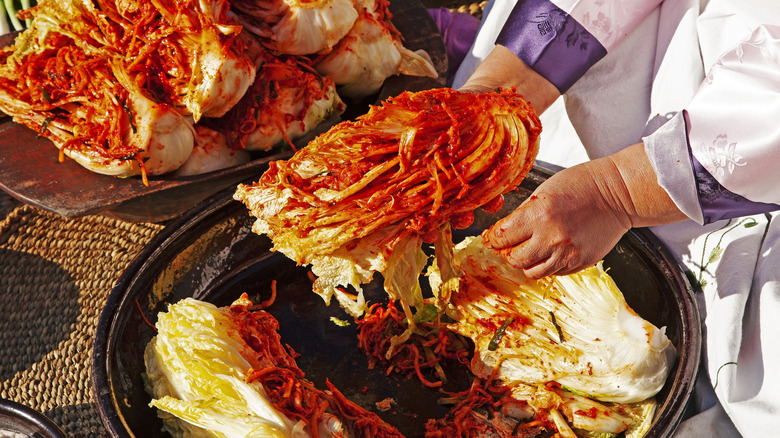
Perhaps the direct translation of the word will clear up any confusion. Son-mat means "hand taste," and it references the flavor of food that's been made with skill and care. This is especially applicable to food made by one's family, which evokes tastes and memories attached to home. As children grow up, they observe the unique way their parents cook, thereby learning their family's son-mat to put into their own cooking.
While this might sound like sentimentality or superstition, that may not be the case. We naturally have microflora and yeast on our hands, so food made by our mothers may have a unique taste per individual. In the case of kimchi, which is a fermented dish, son-mat could play an actual role in the chemical reactions that lend its unique tang and bite. Store-bought kimchi isn't generally handmade, and may not even be fully fermented, so there's no way it could take on the microflora Korean mothers possess. Of course, you should never store kimchi at room temperature, whether it's store-bought or made with love, by hand. Son-mat does many things, but it won't keep kimchi from going bad.
How love and passion can make food taste better
You might notice that food just tastes better in a bowl, when shared with good friends, or after drinking alcohol. While some part of that may be wishful thinking, there's actually a little research to back those experiences up — and there's also science behind why food made with love tastes better. Beyond the yeast from human hands, there's evidence that if someone puts love and kindness into their food, others perceive it differently, heightening certain taste notes.
In one experiment, candy given to participants in a friendly way tasted sweeter than candy given without the kindness. In the U.K., an Oxford study showed that participants widely preferred pastries made by people who loved them rather than trained pastry chefs. This preference for handmade food from the heart seems to be the case in other cultures as well.
While son-mat is a uniquely Korean concept, other countries have their own version of the love-based secret ingredient. The Arabic word "nafas" is a supposed gift that allows a person to instill unique flavors into a dish. In parts of India, the concept of "hatachi chav" has to do with specific tastes imparted to food by each individual. No matter where you go, there's evidence that passion and care translate to tastier cuisine. With this in mind, it probably goes without saying that you can do better than Trader Joe's kimchi if you're looking for that extra touch of son-mat.