

A Popular Grocery Chain Faces Privacy Concerns Over Facial Recognition Tech
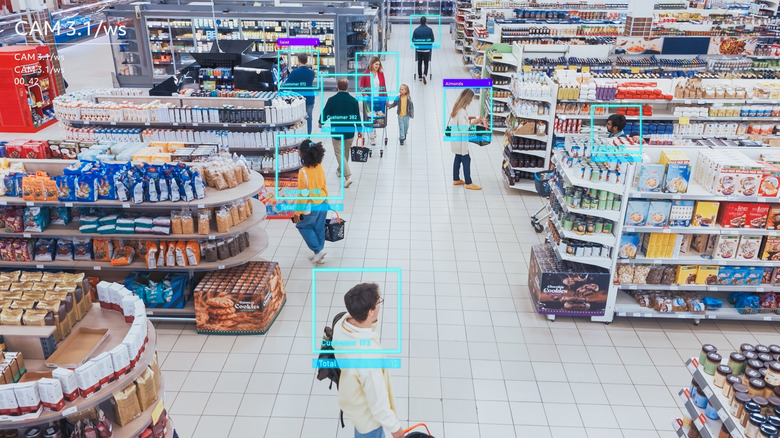
The grocery chain Wegman's has launched facial recognition systems in select stores, which has raised concerns among shoppers and privacy advocates. New signs in the chain's Brooklyn and Manhattan locations alert customers that the stores use "biometric identifier information" to track customers, noting that the store "collects, retains, converts, and stores" the information. The information comprises "facial recognition, eye scans, and voiceprints" (via Grocery Dive).
In a statement to Gothamist, a Wegman's representative explained that the chain uses facial recognition "to help identify individuals who pose a risk to our people, customers, or operation," adding that the tech was deployed "in a small fraction of our stores that exhibit an elevated risk." The Wegman's representative also noted that the system is meant to identify customers who "have been previously flagged for misconduct," and also uses information from law enforcement.
New York law requires stores to alert shoppers if they're using biometric data, which accounts for the sign. But not all states require such signs, leading shoppers in other regions to question whether their own stores are also part of the pilot.
Wegman's is hardly the first retailer to use facial recognition to track customers. Some Kroger locations collect facial recognition data, too. Vending machines track your movements. Burger King Brazil even based an ad campaign around facial recognition. But what does this mean for you?
The problem with facial recognition
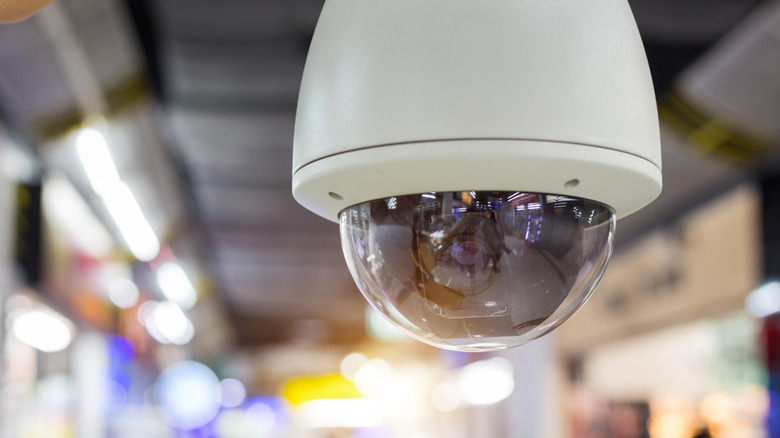
As the debate over Wegman's signage illustrations, regulations for facial recognition technology and practice vary from state to state. Experts worry that there aren't enough laws to protect the public from bad actors in the largely unregulated industry. "If there is a hack or a breach of that data, you can't change your face like you would change a password," executive director of the Surveillance Technology Oversight Project Michelle Dahl told CBS News.
The debate around facial recognition tech isn't just about privacy. The technology is less accurate for some demographics than others — by a shocking margin. A 2019 study analyzing facial recognition programs found that the programs were 10 to 100 times worse at detecting Black and East Asian faces than white ones. Admittedly, the technology has come a long way since that time. Still, the accuracy of facial recognition systems varies between different software algorithms.
Concerned about your privacy, but not willing to give up your favorite grocery store? Cover up. Experts suggest that scarves, face masks, baseball caps, and sunglasses are your best defense against facial recognition.