

If Your Cake Looks Less Than Bakery-Worthy, There's An Expert Way To Hide Flaws
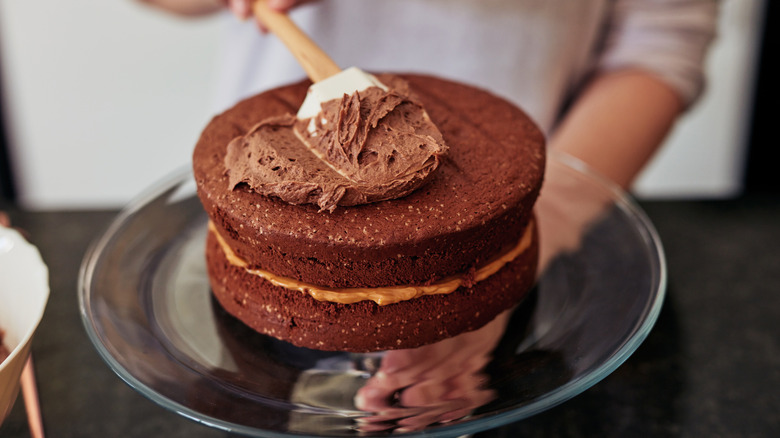
There's nothing like a good cake fail for entertainment value, except when it happens to you. Even if your cake comes out perfect, you might still manage to mess up the frosting, which would be a major bummer. At that point, is there anything you can do to salvage your creation? Bouqedibles cofounder and confectionery chef Victoria Fisk recommends a cover-up job with something you may already have in the pantry.
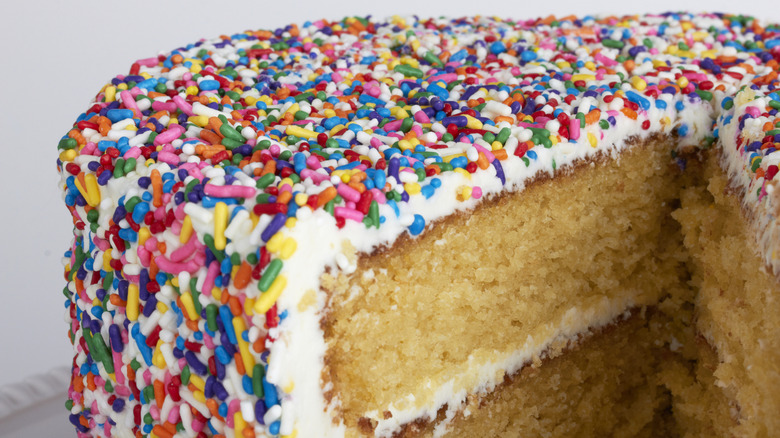
"You can use sprinkles to hide frosting mistakes by creating a visual distraction," she told The Takeout. "Depending on where the mistakes are, I would use sprinkles to create a pattern. For example, you can cover the top and about one-third of the side from the top down so it looks like a candle, with the sprinkles acting like melted wax on the top and sides."
You can also grab cookie cutters from your kitchen drawer to stencil a sprinkle pattern, or simply scatter the sprinkles freeform to coat the cake. Beware, however, that sprinkles (or jimmies, if this is what you call them) are more effective when used to hide lumps or bumps in lighter frosting. "Darker frosting makes imperfections more noticeable," Fisk said. For best adhesion, apply the sprinkles while the frosting is still spreadable. If you've already chilled the frosted cake, let it sit at room temperature until the frosting softens up a bit before hitting it with sprinkles.
More pro tips for flawless cakes
Sprinkles may be colorful, fun, and confectioner-approved, but not everyone's a fan. If you feel that sprinkles never make anything better, there are other methods to fix unsightly cake frosting mistakes. "My pro-baker technique to help hide flaws is to always apply a crumb coat," confectionery chef Victoria Fisk said. "It helps you cover the cake neatly afterward, especially if you catch any mistakes." A crumb coat doesn't involve actual crumbs — instead, it's a thin layer of frosting spread over the cake after you've filled and stacked it, but before you start frosting for real. Essentially, it's the cake equivalent of paint primer. Fisk also pointed out that patience is necessary, reminding us: "Always make sure the cake is fully set before decorating. I usually set it overnight, which keeps the frosting and decorations in place without deforming the cake."
The biggest problem Fisk faces with cake decorating is when the filling starts to ooze out as she's frosting. "In that case, I add another layer of buttercream to cover it or find a way to hide it with décor," she revealed. She cautioned, however, that if you're making a structured cake, choose the base, filling, and frosting carefully. A sturdier cake type — like butter or pound, paired with a non-runny filling and a basic buttercream frosting — will likely work out better than trying to layer an airy angel cake filled with runny jam and frosted with whipped cream. "It is better to create something simple, efficient, and neatly executed than to serve a delicious but unstable cake, unless you are baking for family and friends who will probably forgive you," Fisk said.